By Dr. Asnat Raziel, bariatric surgeon specializing in obesity treatment, metabolic health and healthy longevity; Director of the Multidisciplinary Center for Obesity Treatment, Assia Medical, Assuta Ramat HaChayal, Tel Aviv
Senescent cells: why everyone is talking about them
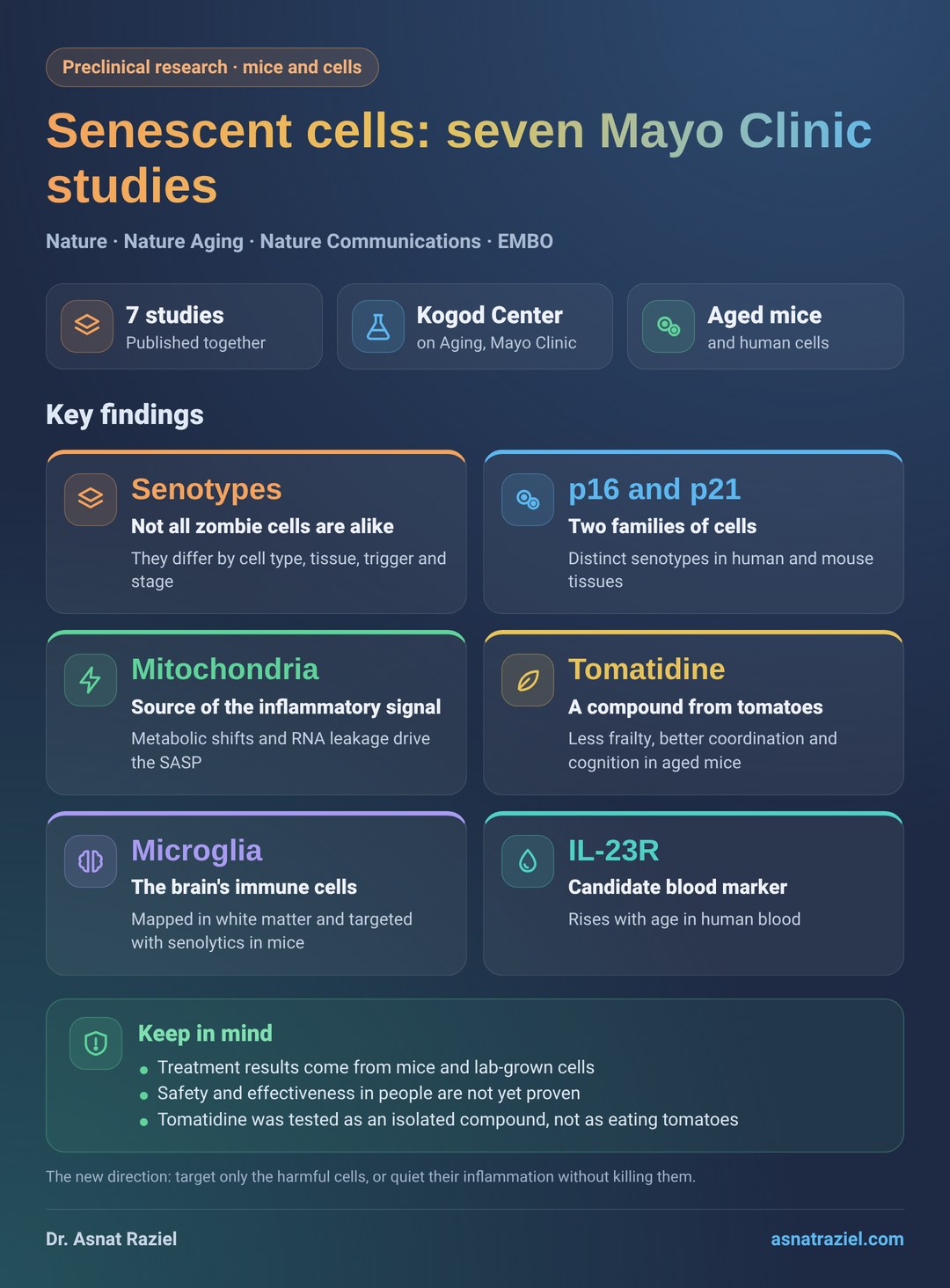
Senescent cells are one of the hottest topics in longevity science. Mayo Clinic researchers recently published a series of seven studies on these cells. The main conclusion is surprising: not all “zombie” cells are the same. So in the future, we may not need to wipe them all out. Instead, we could aim precisely at the ones that do harm.
What are zombie cells?
Over the years, some of the body’s cells stop dividing. However, they don’t die and they aren’t cleared away. Instead, they stay active and release inflammatory substances. Researchers call this state senescence: the cell has stopped its division cycle but is still active.
The mix of substances these cells release is called the SASP (senescence-associated secretory phenotype), a kind of inflammatory message to the surrounding tissue. This inflammation damages nearby tissue and contributes to frailty and to the diseases of older age. I have written before about the natural clean-up system that weakens with age, and about an experimental peptide against zombie cells.
Senescent cells are not a single group
A central paper in the series, published in Nature Aging, proposes a new term: the senotype, a defined type of senescent cell. According to the paper, senescent cells differ by cell type and tissue. They also differ by what triggered their aging and by the stage they have reached. That is why the researchers recommend classifying them by a combination of features rather than by a single marker.
Another study, in The EMBO Journal, compared cells that express the proteins p16 and p21. Both proteins are standard markers of cellular aging. The researchers found distinct senotypes in the two groups, in both human and mouse tissue.
Mitochondria light the fire
Two studies in the series looked at where the inflammatory signal comes from. In Nature, the researchers showed that changes in the metabolism of mitochondria, the cell’s power plants, alter how inflammatory genes are switched on. The change works through an epigenetic mechanism, meaning control over which genes are on or off without changing the DNA sequence.
In addition, in Nature Communications the team described RNA leaking out of the mitochondria into the cell. This leakage triggers an immune response and drives the SASP. The implication is intriguing: it may be possible to block the inflammation itself without killing the cells.
What helped older mice
The researchers tested several treatment approaches in older mice. First, senolytics, drugs that eliminate senescent cells. Second, a natural compound from tomatoes. Finally, genetic removal of specific cell populations. Depending on the approach, the mice showed fewer inflammatory markers and less frailty. At the same time, brain inflammation went down and performance on cognitive tests improved.
One study, in Nature Aging, mapped microglia, the brain’s immune cells, in the white matter of older mouse brains. The researchers also tested a senolytic treatment aimed at these cells.
Tomatidine from tomatoes
In a study published in EMBO Molecular Medicine, the researchers screened a small group of natural products. This is how they identified tomatidine, a compound that comes from tomatoes. In aging human cells, tomatidine suppressed the SASP without changing p16 and p21 levels. That is, it calmed the inflammation without killing the cells.
In older mice, tomatidine reduced frailty and improved motor coordination and cognitive performance. It also lowered markers of cellular aging in the liver, skin and hippocampal neurons, and reduced inflammation in the brain. Keep in mind that the study tested an isolated compound in mice, not eating tomatoes.
A blood test for senescent cells?
Another study, published in Nature Aging, looked for markers in the blood. In mice, the levels of several blood proteins changed with age, including IL-23R. Senolytic treatments such as venetoclax, navitoclax, fisetin or luteolin reversed some of these changes. In blood from people of different ages, IL-23R levels also rose with age.
That makes IL-23R a candidate blood marker for measuring the body’s burden of senescent cells. The team had also previously developed SenMayo, a gene set that identifies senescent cells across different tissues. Tests like these matter, because without reliable measurement it is hard to know whether a treatment really works.
What this means for us
These studies point to a new direction: precision medicine against aging. Rather than wiping out every zombie cell, we may be able to target only the harmful populations. Alternatively, we could block just their inflammatory signals. That said, all of the treatment results came from mice and lab-grown cells. The researchers themselves stress that safety and effectiveness in people have not yet been shown.
Meanwhile, senolytic drugs are already being tested in clinical trials, for example in fatty liver disease. For anyone who wants a personal plan, longevity medicine connects this science with daily life. It starts with familiar habits: physical activity, good nutrition and sleep.
The bottom line on senescent cells
The Mayo Clinic series changes the picture. Senescent cells are not a uniform enemy but a family of different types. Some are harmful, and some may be better calmed than destroyed. This is an important step toward targeted treatments, but the road to the clinic is still long.
This article provides general information and is not personal medical advice.
References
Mayo Clinic discovers new ways to fight the “zombie” cells that drive aging
Senotypes define the diverse landscape of senescent cells
Distinct senotypes in p16- and p21-positive cells across human and mouse aging tissues
Mitochondrial metabolism and epigenetic crosstalk drive SASP
Mitochondrial RNA cytosolic leakage drives the SASP
IL-23R is a senescence-linked circulating and tissue biomarker of aging