By Dr. Asnat Raziel, bariatric surgeon specializing in obesity treatment, metabolic health and healthy longevity; Director of the Multidisciplinary Center for Obesity Treatment, Assia Medical, Assuta Ramat HaChayal, Tel Aviv
Exercise energy compensation: why walking doesn’t take off the expected weight
Exercise energy compensation is the way the body offsets part of the energy we burn in a workout. That is why people who start walking regularly often lose less weight than they expected. An Israeli study presented at ObesityWeek 2026 looked at exactly where the body “saves.” The answer is surprising: weight barely moved, but fat went down and lean mass went up.
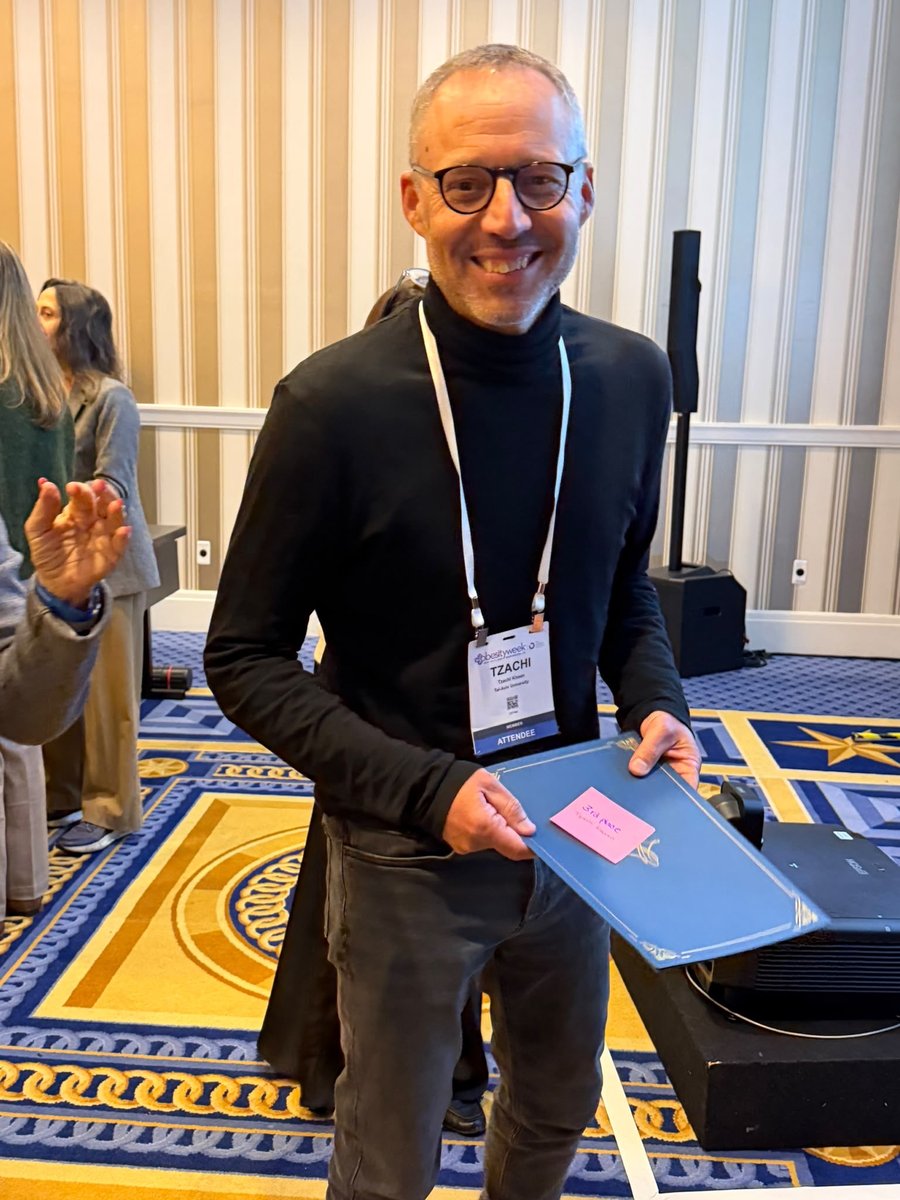
The study was presented by Tzachi Knaan of the School of Public Health and the Sylvan Adams Sports Institute at Tel Aviv University. He worked with Yftach Gepner of Tel Aviv University and Ed Melanson of the University of Colorado. Knaan won third place in the meeting’s Early Career Lightning Talks competition.
What did the study look at?
Sixteen adults aged 21 to 45 with overweight took part. None of them exercised regularly before the study. Their average age was 39, their average body mass index (BMI) was 28.1, and half of them were women.
For 12 weeks they walked at moderate intensity, at 65% to 75% of their maximum heart rate. Each person had a tailored plan designed to burn 20 calories per kilogram of body weight each week. A heart-rate sensor tracked every session. On average, participants walked about 200 minutes a week, or about 28 minutes a day. Adherence reached 95%, and no one was injured.

The researchers measured energy use with doubly labeled water, the reference method for measuring calories burned in daily life. Participants also stayed in a sealed metabolic room that measures oxygen use during sleep, rest and a meal. MRI scans measured the volume of the liver, kidneys, brain and visceral fat.
The results: weight stayed, fat went down
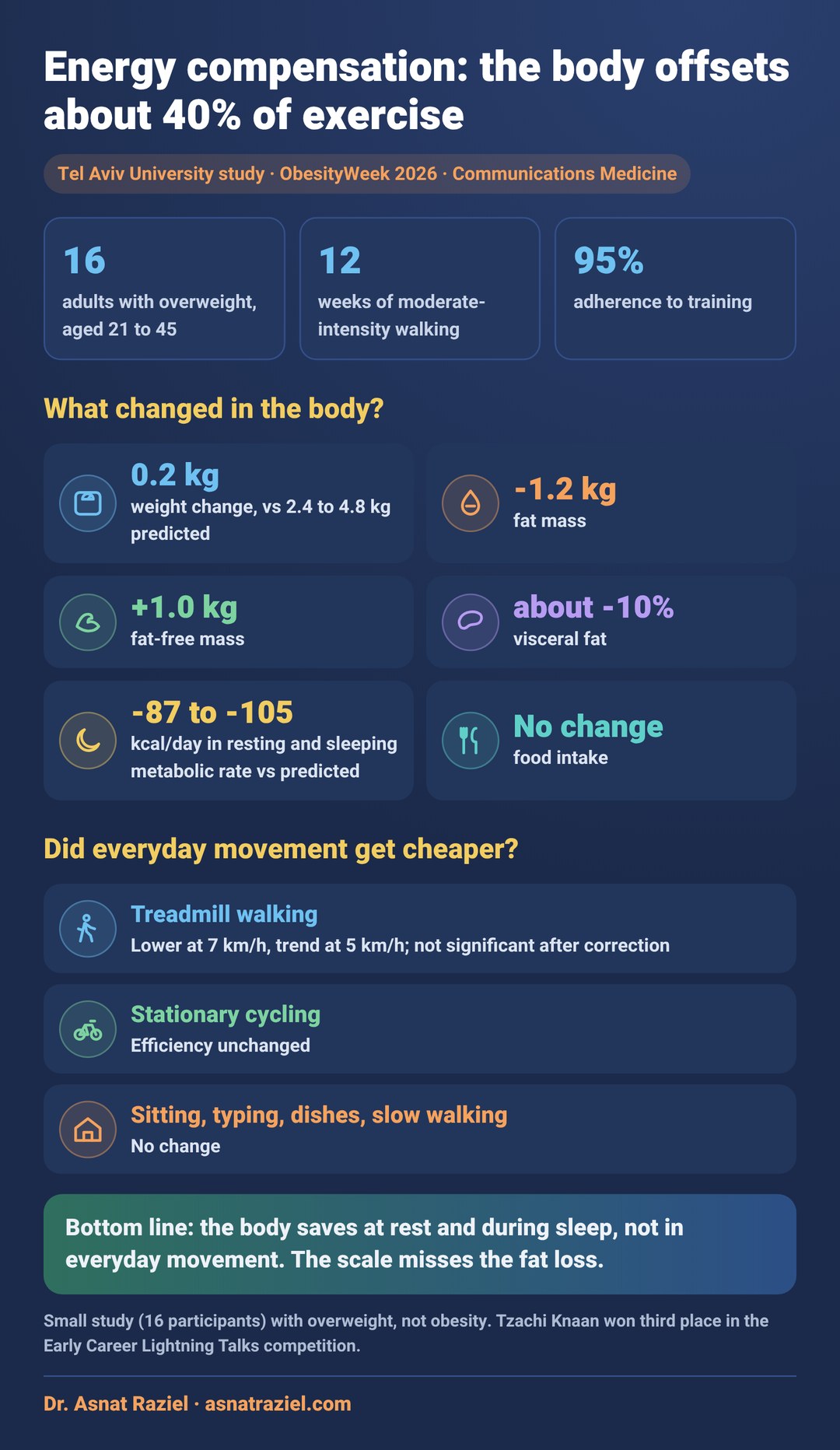
Standard models predicted a weight loss of 2.4 to 4.8 kg. In reality, the average change in weight was only 0.2 kg, which was not statistically significant. However, body composition improved:
- Fat mass dropped by 1.2 kg.
- Fat-free (lean) mass rose by 1.0 kg.
- Visceral fat, the fat around the abdominal organs, fell by about 10%.
- Aerobic fitness (VO2max) improved.
Notably, waist circumference did not change. In other words, neither the tape measure nor the scale picked up the drop in visceral fat.
Where does the body save? Exercise energy compensation at rest
The researchers calculated that the body offset about 40% of the energy spent walking, roughly 97 calories a day on average. Eleven of the 16 participants showed this kind of exercise energy compensation. So where did the calories go?
First, eating did not change. Food diaries and an objective calculation of energy intake both showed similar intake before and after the program. Second, metabolic rate at rest and during sleep fell by 87 to 105 calories a day compared with what was predicted. According to the researchers, this drop explains nearly all of the compensation.
The team also found a 3.8% decrease in liver volume and a 5.1% decrease in kidney volume, while brain volume did not change. By their calculation, this explains about 20% of the savings at rest. In a parallel mouse model, by contrast, training increased cell density and mitochondria in the liver. This is an early finding that still needs testing in people.
Did everyday movement get “cheaper”?
This was the central question of Knaan’s talk. Activities that are not exercise, such as sitting, typing, washing dishes and slow walking, make up NEAT (Non-Exercise Activity Thermogenesis), the energy we burn in daily movement outside workouts. It is usually estimated indirectly, for example with a smartwatch. But a watch measures movement, not energy.
So the researchers directly measured the energy each activity used, before and after training:
- On a treadmill at 3 to 7 km/h, energy use fell at 7 km/h, with a similar trend at 5 km/h. However, after statistical correction for multiple comparisons, neither finding remained significant.
- On a stationary bike at three intensities (10, 25 and 50 watts), efficiency did not change.
- Sitting, typing, washing dishes and slow walking at 2 km/h showed no change.
Knaan’s conclusion was that the body may become more efficient at the specific task it trains, such as walking. Yet the team could not show any energy savings in everyday movement itself. Put simply, exercise energy compensation does not happen because washing dishes suddenly “costs” fewer calories.
What this means for you
This was a small study of only 16 people, all relatively young and with overweight rather than obesity. So it is not a basis for sweeping conclusions. Still, it points to some practical messages:
- Don’t judge exercise by the scale alone. Less visceral fat and more lean mass are important health gains, even when weight doesn’t move. A body composition test shows the change far better than weight does.
- To lose weight, combine diet and activity. Walking alone led to a negligible change in weight here.
- Plan for the compensation. The researchers suggest that exercise guidelines for weight loss add about 40% to the activity volume, or tailor it to each person.
- Add strength training. Gaining lean mass may help support your metabolic rate.
- Keep moving through the day. In this study, everyday movement did not become more economical. That means steps, stairs and standing keep burning energy as usual. See also my physical activity prescription.
The body reacts in a similar way to dieting, too: metabolic rate often slows after weight loss, another sign of how hard the body works to protect its energy stores.

Bottom line on exercise energy compensation
The body guards its energy reserves. When you add walking, it slightly lowers metabolic rate at rest and during sleep, rather than saving on everyday movement. That is why the scale doesn’t always reflect what you’ve achieved. Even so, walking cut visceral fat, added lean mass and improved fitness. These are exactly the changes that protect health over the years.
This article provides general information and is not personal medical advice. Talk to your doctor before changing your exercise plan or treatment.
Sources
Multilevel metabolic adaptation to exercise training
ClinicalTrials.gov: NCT04460040
Exercise-Induced Energy Compensation is NOT Mediated by Habitual Activity Metabolic Economy – talk by Tzachi Knaan, ObesityWeek 2026.