By Dr. Asnat Raziel, bariatric surgeon specializing in obesity treatment, metabolic health and healthy longevity; Director of the Multidisciplinary Center for Obesity Treatment, Assia Medical, Assuta Ramat HaChayal, Tel Aviv
Wegovy for heart patients: what we know today
Wegovy for heart patients is one of the topics people ask me about most often in the clinic. This article is written for those who already live with heart disease, such as a past heart attack, stroke or cardiac catheterization, peripheral artery disease or heart failure, and who also carry excess weight. Wegovy is a weekly injection for treating obesity. However, we now know that it does more than lower weight. In a large trial, it cut the risk of heart attack, stroke and death from heart disease by 20% in people with heart disease and overweight. Below, I explain what exactly the research found, who it applies to, and what to know before you start.
Why excess weight burdens the heart
Obesity is not just a number on the scale. Fat tissue, especially around the belly, releases substances that promote chronic inflammation. In addition, it raises blood pressure, disrupts blood sugar control and upsets blood lipid levels. All of these speed up atherosclerosis, the buildup of plaque in the walls of the blood vessels.
As a result, the risk of heart attack, stroke and heart failure goes up. That is why significant weight loss is part of treating the heart, not just the body.
What Wegovy is and how it works
The active ingredient in Wegovy is semaglutide, at a dose of 2.4 mg injected once a week. Semaglutide mimics GLP-1, a gut hormone that increases fullness and slows stomach emptying. As a result, appetite drops and “food noise” quiets down.
Beyond that, the drug has effects on the heart itself. It slightly lowers blood pressure, improves blood sugar and lipid levels, and reduces markers of inflammation. I describe where it fits among the other options in my review of drug treatment for obesity and metabolic disease.
Wegovy for heart patients: what the SELECT trial showed
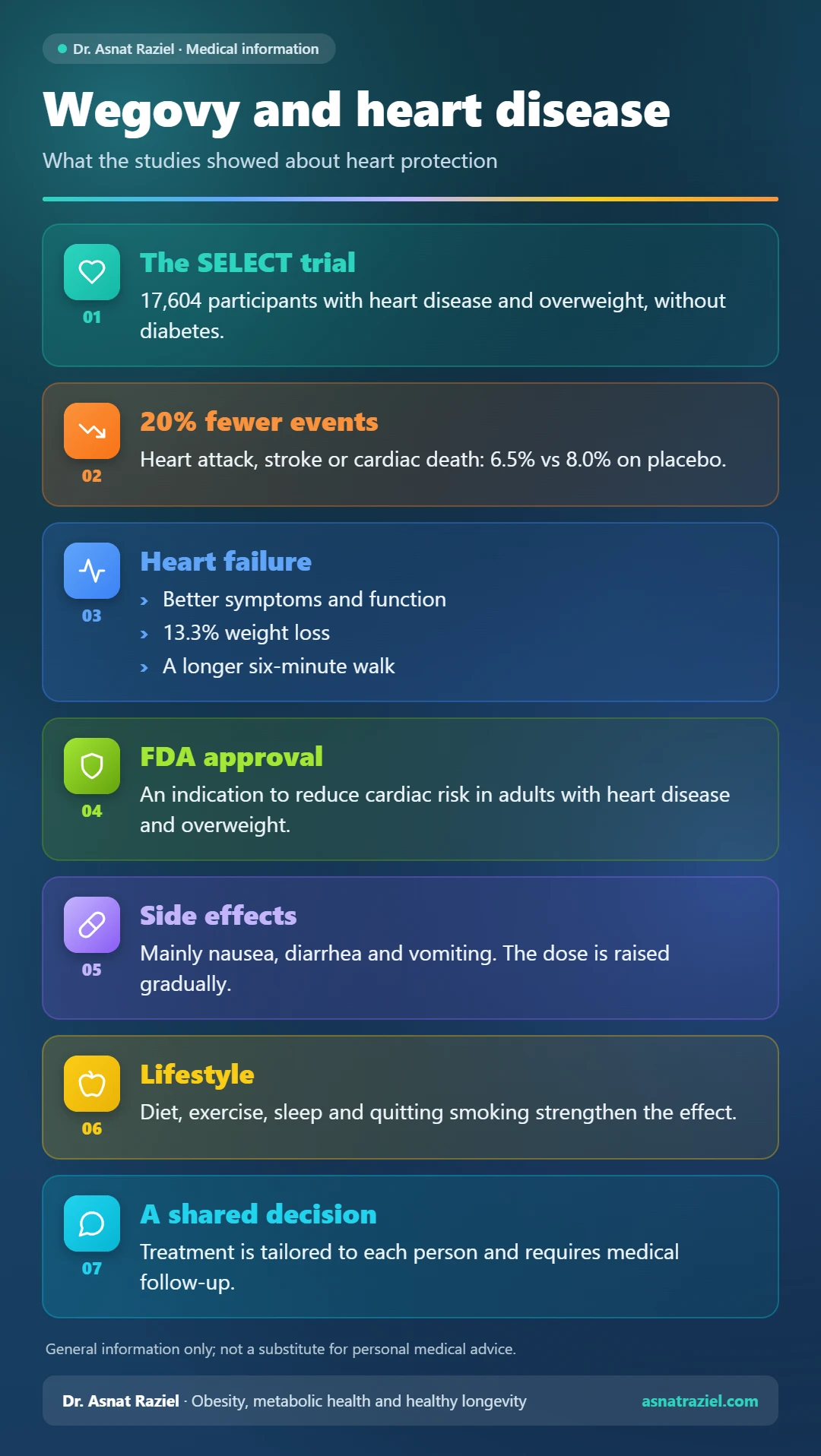
The SELECT trial is the key study in this field. It included 17,604 participants aged 45 and over with established cardiovascular disease and a BMI of 27 or higher. Importantly, none of them had diabetes. Each participant randomly received either Wegovy 2.4 mg or a placebo injection, and the average follow-up lasted 39.8 months.
The researchers looked at a combined measure: death from heart disease, heart attack or stroke. In the Wegovy group, such an event occurred in 6.5% of participants. By contrast, it occurred in 8.0% of the placebo group. In other words, the relative risk fell by 20%.
What these numbers mean in practice
In absolute terms, for every 100 such patients, Wegovy prevented about 1.5 major cardiac events over roughly three years. That may sound small, but these are heart attacks and strokes that never happened. What’s more, this benefit came on top of usual care, which already included heart medications. You can find more detail in my article on the full results of the SELECT trial.
Wegovy and heart failure with preserved ejection fraction
Heart failure with preserved ejection fraction (HFpEF) is a condition in which the heart muscle contracts normally but is stiff and fills with difficulty. It is very common in people with obesity. The main symptoms are shortness of breath, fatigue and swelling in the legs.
The STEP-HFpEF trial followed 529 patients with this condition and a BMI of 30 or higher for 52 weeks. In the Wegovy group, the symptom score on a standard questionnaire improved by 16.6 points, compared with 8.7 points on placebo. In addition, body weight fell by 13.3%, compared with 2.6% on placebo. The six-minute walking distance grew by 21.5 meters, versus only 1.2 meters. Finally, the inflammation marker CRP dropped by 43.5%, compared with 7.3%.
FDA approval and who it is for
On March 8, 2024, the US Food and Drug Administration approved a new indication for Wegovy. The indication is to reduce the risk of cardiovascular death, heart attack and stroke in adults with cardiovascular disease and either obesity or overweight. It was the first obesity medication to receive such an indication.
Put simply, the case for Wegovy for heart patients applies mainly to people who have already had a heart attack, a stroke or a cardiac catheterization, or who have peripheral artery disease, and who also carry excess weight. On the other hand, SELECT did not test the effect on cardiac events in people without known heart disease. Therefore, the decision to treat should be made together with a doctor, based on the full picture.
Wegovy for heart patients: questions to ask your cardiologist
If you live with heart disease and excess weight, these are the points worth raising at your next visit:
- Do I match the SELECT population, with known heart disease and a BMI of 27 or higher?
- Do I have heart failure with preserved ejection fraction, where STEP-HFpEF showed better symptoms and a longer walking distance?
- Can I keep taking all my current heart medications? In SELECT, most participants did.
- Do I or my family have a history of medullary thyroid cancer or MEN2?
- How will we raise the dose gradually, and who will monitor side effects?
For a broader look at how the active ingredient may protect the heart beyond weight loss, see my article on semaglutide and heart protection.
Side effects and safety
The common side effects are mainly digestive: nausea, diarrhea, vomiting, constipation and abdominal pain. In SELECT, 16.6% of patients on Wegovy stopped treatment because of side effects, compared with 8.2% on placebo. For this reason, when I prescribe Wegovy for heart patients, we raise the dose gradually and follow them closely.
In addition, there are warnings worth knowing:
- Do not use the drug if you have a personal or family history of medullary thyroid cancer or MEN2 syndrome.
- Pancreatitis and gallbladder problems, including gallstones.
- A slight rise in resting heart rate.
- A risk of kidney injury if vomiting or diarrhea leads to dehydration.
- Low blood sugar, mainly in combination with insulin or drugs that increase insulin release.
Medication does not replace a healthy lifestyle
Even the best treatment, including Wegovy for heart patients, works much better when it goes hand in hand with new habits. A diet rich in vegetables, regular physical activity, good sleep and quitting smoking all protect the heart in their own right. I covered this in detail in my article on a heart-healthy lifestyle alongside weight-loss drugs.
Beyond that, new studies are also exploring other mechanisms. For example, there is research on heart protection with GLP-1 drugs after a heart attack. Another study showed that weight loss after surgery improves the biological age of the heart. Similarly, aging research, such as the study on a gene that slows aging, reminds us that heart health is part of overall health over the years.
The bottom line
The evidence on Wegovy for heart patients now rests on large, high-quality trials. In SELECT, Wegovy reduced major cardiac events by 20% in people with heart disease and overweight, even without diabetes. In STEP-HFpEF, it improved symptoms and function in heart failure with preserved ejection fraction. Still, it is a medication with side effects, and it requires personal tailoring and follow-up. If you have heart disease and excess weight, it is worth discussing this option with your doctor.
The information in this article is general and does not replace personal medical advice.
Frequently asked questions
Is Wegovy suitable for everyone with heart disease?
Not necessarily. The trial included people with known heart disease and a BMI of 27 or higher. The decision depends on weight, other medical conditions and other medications.
Does the heart protection depend only on weight loss?
Researchers are still studying this question. Most likely, lower blood pressure, less inflammation and better blood sugar also contribute to the effect.
Can I take Wegovy alongside heart medications?
Yes. In the SELECT trial, most participants kept taking their usual heart medications. In any case, it is important to keep your cardiologist informed.
What happens to heart patients who stop Wegovy?
After stopping, weight tends to come back gradually, and some of the risk factors return with it. That is why we see it as long-term treatment for a chronic disease.
References
Semaglutide and Cardiovascular Outcomes in Obesity without Diabetes
Semaglutide in Patients with Heart Failure with Preserved Ejection Fraction and Obesity
The SELECT and STEP-HFpEF trials were funded by Novo Nordisk, the maker of Wegovy.




