By Dr. Asnat Raziel, bariatric surgeon specializing in obesity treatment, metabolic health and healthy longevity; Director of the Multidisciplinary Center for Obesity Treatment, Assia Medical, Assuta Ramat HaChayal, Tel Aviv
Mounjaro FDA approval: what the label actually says
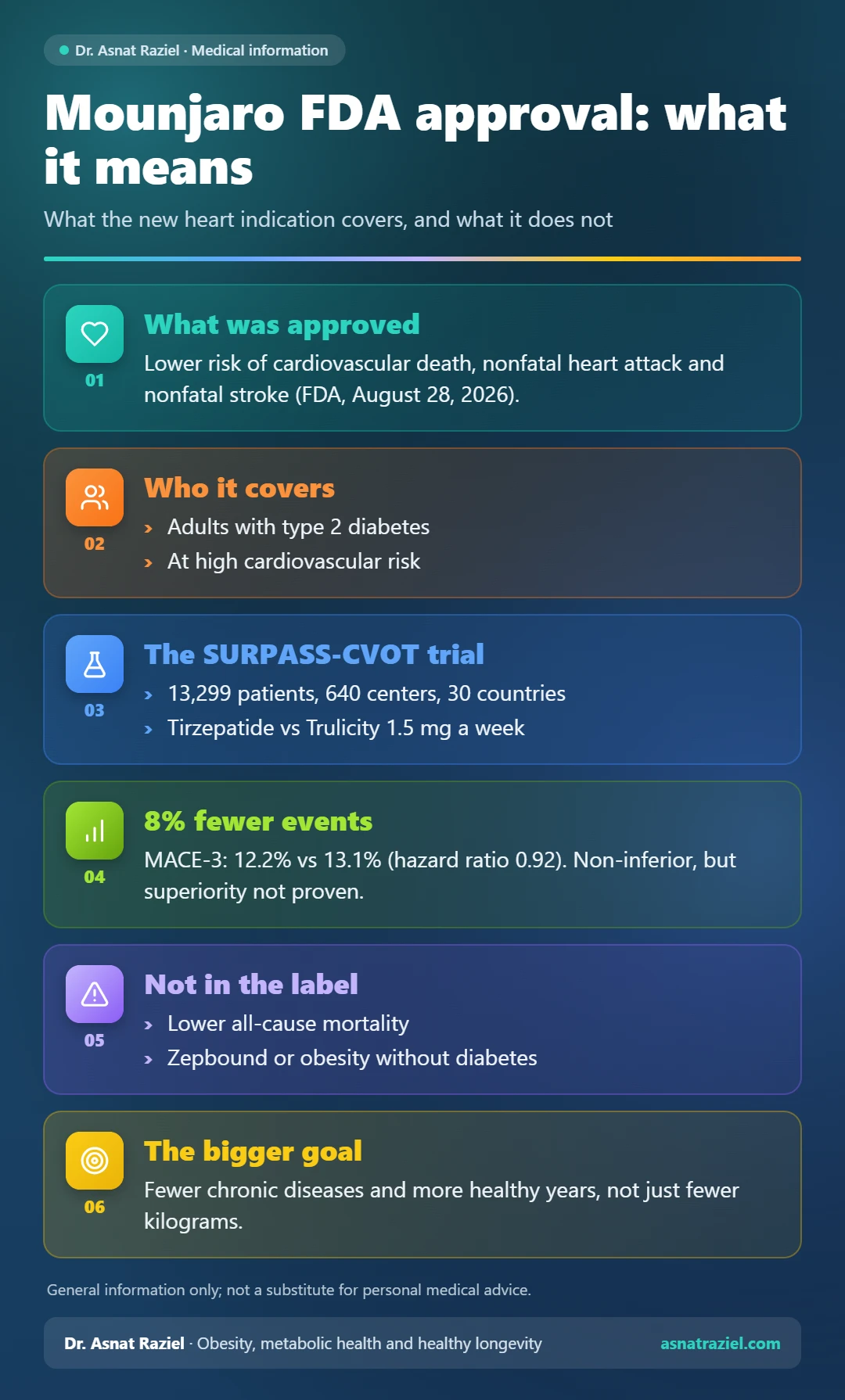
The Mounjaro FDA approval for the heart made plenty of headlines, and it also caused some confusion. In this article, I focus on a practical question: what the approval actually says, who it applies to, and which conclusions it does not support. Mounjaro, whose active ingredient is tirzepatide, has transformed the treatment of type 2 diabetes and obesity in recent years. On August 28, 2026, the FDA (the US Food and Drug Administration) approved an expanded indication. The drug is now also approved to reduce the risk of major cardiovascular events in adults with type 2 diabetes who are at high risk.
The new indication covers a lower risk of cardiovascular death, nonfatal heart attack and nonfatal stroke. This changes the way we look at the drug. In other words, we no longer see it only through the lens of weight or blood sugar. Instead, it becomes part of a comprehensive approach to cardiometabolic risk.
What the Mounjaro FDA approval rests on: the SURPASS-CVOT trial
The approval rests on the SURPASS-CVOT trial, which appeared in the New England Journal of Medicine. Overall, it enrolled 13,299 patients with type 2 diabetes and established atherosclerotic cardiovascular disease. Their average age was 64.1 years and their average BMI was 32.6. Their average HbA1c, a measure of average blood sugar over the past three months, was 8.4%. In addition, they had lived with diabetes for an average of 14.7 years.
The trial ran at 640 centers in 30 countries, with a median follow-up of about four years. Yet one of its most interesting features is actually the comparison group.
A strong rival instead of a placebo
Instead of a placebo, the researchers chose a strong competitor: Trulicity (dulaglutide), at 1.5 mg a week. Trulicity belongs to the GLP-1 family and has already shown a benefit for the heart. The other group received tirzepatide at up to 15 mg a week, or the highest dose each patient could tolerate.
As a result, the bar was high. The question was not whether Mounjaro is better than nothing. Rather, the question was how it performs against a treatment that already protects the heart. According to Lilly, this was the first head-to-head trial to compare two incretin-based drugs on heart outcomes.
8% fewer events: not proof of superiority
First, the primary endpoint was MACE-3, a combination of three events: cardiovascular death, heart attack or stroke. Such an event occurred in 12.2% of patients on tirzepatide, compared with 13.1% on dulaglutide. The hazard ratio was 0.92, which means roughly 8% lower risk.
However, precision matters when you read the Mounjaro FDA approval. The researchers designed the trial to show that tirzepatide is not inferior to Trulicity, and it clearly reached that goal. By contrast, the 8% advantage was not enough to prove superiority. The confidence interval was 0.83–1.01, and the p-value for superiority was 0.09. So it is fair to say that Mounjaro protected the heart at least as well as a proven heart-protective drug, with a numerical trend in its favor. It is not accurate to say that it was proven better.
Does the approval cover lower mortality? No
There is another interesting finding here. According to an analysis by the British Cardiovascular Society, all-cause mortality was 8.6% in the Mounjaro group, compared with 10.2% in the Trulicity group. The hazard ratio was 0.84, a reduction of about 16%. This drop came mainly from deaths that were not cardiovascular.
Even so, we need caution here as well. All-cause mortality was a secondary endpoint, so this finding generates a hypothesis rather than proof. Moreover, the Mounjaro FDA approval covers fewer cardiovascular events, not lower overall mortality. For data from everyday practice, see my article on what real-world studies show about Mounjaro and the heart.
What the Mounjaro FDA approval does say: far beyond blood sugar
The approval reflects a deep shift in how we treat type 2 diabetes. For years, the main goal was to lower blood sugar and HbA1c. Today it is clear that this is only part of the story. Type 2 diabetes is linked to obesity, belly fat, high blood pressure, abnormal blood lipids, kidney disease and atherosclerosis. Therefore, the key question is whether a treatment reduces the diseases that harm quality of life and life expectancy. I discuss this further in my article on Mounjaro and the metabolic revolution in diabetes care. For a patient-focused view, see my practical guide for people with diabetes and heart disease, including questions to ask your doctor.
Notably, Mounjaro acts on two receptors, GIP and GLP-1. According to Lilly, it is the first drug of its kind proven to lower the risk of heart attack, stroke or cardiovascular death in this population. In Europe, the company says, the trial data have already been added to the drug’s label.
Who the approval does not cover: Zepbound and obesity without diabetes
It is important to distinguish between the two brand names. In the United States, Lilly sells tirzepatide as Mounjaro for type 2 diabetes, while for obesity it uses the name Zepbound. The Mounjaro FDA approval applies to this brand and to adults with type 2 diabetes at high cardiovascular risk. Therefore, it does not mean that everyone with obesity but without diabetes now has the same indication.
Another large trial, SURMOUNT-MMO, is testing the effect of tirzepatide on illness and death in people with obesity or overweight. In the future, it may give a broader answer about the heart in people without diabetes.
Mounjaro FDA approval: five common misreadings
In conversations with patients, I hear several misreadings of the approval. Here are the most common ones:
- “Mounjaro was proven better than Trulicity.” Not quite. It was proven non-inferior, and the 8% difference did not reach the significance needed to prove superiority.
- “Mounjaro lowers mortality.” The roughly 16% drop in all-cause mortality is a secondary finding. It is not part of the indication.
- “The approval covers everyone with obesity.” No. It covers adults with type 2 diabetes at high cardiovascular risk.
- “Zepbound received the same approval.” No. The new approval applies to Mounjaro.
- “Weight loss is the whole goal.” In fact, the real goal is fewer chronic diseases over the years, not just fewer kilograms.
For a detailed look at the trial design and results, read my in-depth review of the SURPASS-CVOT trial.
The race for the heart, not just the scale
In fact, the approval is part of a broader race among drug companies. Back in March 2024, Novo Nordisk received FDA approval for Wegovy to reduce cardiovascular events in adults with heart disease and overweight or obesity. That approval was based on the SELECT trial of Wegovy. With the Mounjaro FDA approval, tirzepatide now officially joins this field. From here on, the competition is not only about kilograms or HbA1c. The central question is which drug prevents disease and keeps people healthy over time.
What comes next?
At the same time, Lilly is also developing new drugs. Foundayo (orforglipron) is a once-daily GLP-1 pill. The FDA approved it for the treatment of obesity on April 1, 2026. In September 2026, the full results of the ACHIEVE-4 trial appeared in The Lancet. The trial included 2,749 adults with type 2 diabetes, overweight and increased cardiovascular risk. Foundayo was non-inferior to insulin glargine on cardiovascular safety, with a hazard ratio of 0.84. For now, Foundayo is still not approved in the United States for diabetes. You can read more in my guide to treatment with Foundayo.
Meanwhile, retatrutide is also moving forward. This drug activates three receptors: GIP, GLP-1 and glucagon. Its trials, too, look beyond weight to heart and kidney outcomes. I wrote about this in my article on the retatrutide phase 3 trials.
Heart protection through a longevity lens
This development fits well with the modern view of metabolic health. Weight loss matters, but it is not the end goal. The goal is to reduce belly fat, improve blood pressure and blood lipids, preserve muscle and bone, and improve fitness. In addition, the goal is to lower the long-term risk of diabetes, heart disease, stroke and kidney disease. Ultimately, the question is not how many kilograms a patient loses, but whether they stay healthy for many years. The Mounjaro FDA approval is another step in that direction.
The information in this article is general and does not replace personal medical advice.
Frequently asked questions
What exactly did the FDA approve for Mounjaro?
The FDA approved Mounjaro to reduce the risk of major cardiovascular events: cardiovascular death, nonfatal heart attack or nonfatal stroke. The approval applies to adults with type 2 diabetes who are at high risk of these events.
Did Mounjaro lower the risk compared with Trulicity?
Overall, the Mounjaro group had about 8% fewer MACE-3 events. However, the difference did not reach the statistical significance needed to prove superiority. The trial clearly showed that Mounjaro is not inferior to Trulicity.
Does the approval also apply to people with obesity but no diabetes?
No. The approval refers to adults with type 2 diabetes at high cardiovascular risk. Other trials, most notably SURMOUNT-MMO, are now testing the effect on the heart in people with obesity but no diabetes.
Are Mounjaro and Zepbound the same drug?
Both contain the same active ingredient, tirzepatide. In the United States, Mounjaro is marketed for type 2 diabetes, and Zepbound for obesity and the other indications approved for it.
What is the key message of the Mounjaro FDA approval?
Modern treatment of diabetes and obesity goes beyond lowering blood sugar and weight. The aim is to reduce chronic disease and add healthy years. In this way, the link between Mounjaro and heart health now has official backing.
References
Cardiovascular Outcomes with Tirzepatide versus Dulaglutide in Type 2 Diabetes
The studies were funded by Eli Lilly, the drug’s manufacturer.




