By Dr. Asnat Raziel, bariatric surgeon specializing in obesity treatment, metabolic health and healthy longevity; Director of the Multidisciplinary Center for Obesity Treatment, Assia Medical, Assuta Ramat HaChayal, Tel Aviv
Geroprotectors: how do scientists find them?
Geroprotectors are compounds that may slow down wear and tear in our cells. Now, a new study has presented a clever way to find them. The researchers analyzed gene expression patterns in worms and mice. As a result, they identified seven promising compounds.
The researchers published the study in the journal Science Advances. Moreover, it shows how genomic tools can speed up drug discovery. In fact, the approach turns a random search into a targeted one.
What are “longevity modules”?
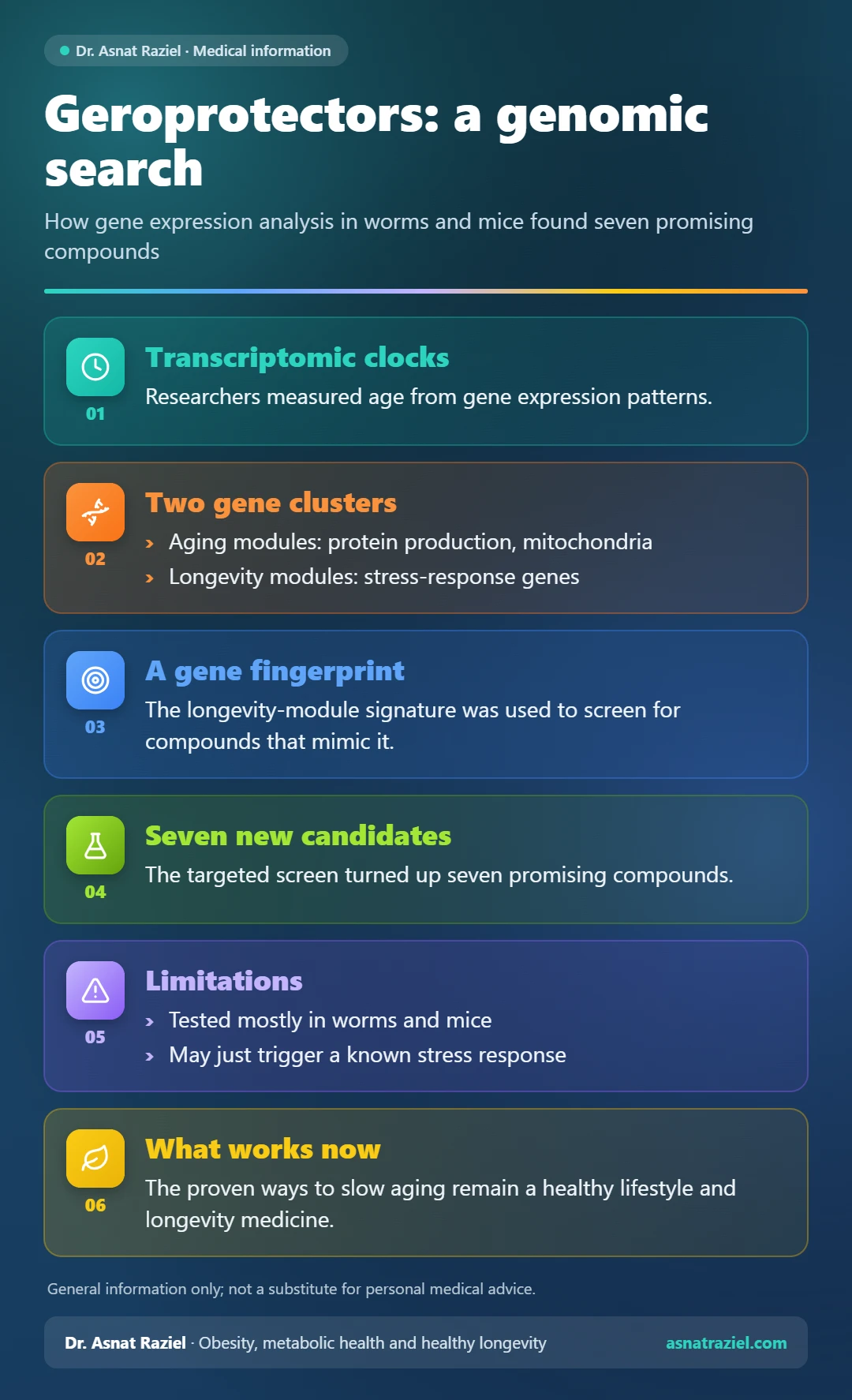
The search for geroprotectors began with measurement. The researchers used “transcriptomic clocks,” which means they measured age from gene expression patterns. In addition, they grouped together genes that switch on and off at the same time. Consequently, this analysis revealed clusters of genes linked to lifespan.
The researchers called one cluster “aging modules,” and it relates to protein production and the mitochondria. They called a second cluster “longevity modules,” and it relates to stress-response genes. Interestingly, some changes that scientists considered harmful turned out to be adaptive.
Geroprotectors: how were the seven compounds found?
This is where creative thinking came in. The researchers used the gene signature of the longevity modules as a kind of fingerprint. Next, they searched for compounds that produce a similar signature. Finally, the screen turned up seven new candidates.
In short, this approach steers the search toward the desired biological target. Therefore, it is far more efficient than trial and error. Some of the modules also appeared in mouse tissues, in relation to the animals’ health.
Why does this approach matter?
The field of longevity medicine is looking for science-based interventions. A systematic method for discovering geroprotectors could greatly accelerate the field. Furthermore, it may help bridge basic research and clinical trials. You can read more about related tools in my article on biohacking, NAD+ and peptides.
Geroprotectors: what are the limitations?
First, the researchers did most of the testing in worms and mice. In other words, the road to humans is still long. Second, critics point out that many compounds of this kind simply trigger a familiar stress response. So it remains to be seen whether they are truly better than what we already have. Ultimately, researchers need clinical validation before drawing any conclusions.
The bottom line
Researchers have identified new geroprotectors through gene expression analysis. Overall, this approach is targeted, smart and promising. However, the seven compounds are only at the very beginning of the road. Meanwhile, the proven ways to slow aging remain a healthy lifestyle and longevity medicine.
The information in this article is general and is not a recommendation to take any compound or supplement. Consult a physician before starting any treatment.
Sources
Transcriptomic Approaches to Guiding the Discovery of Geroprotective Compounds




