By Dr. Asnat Raziel, bariatric surgeon specializing in obesity treatment, metabolic health and healthy longevity; Director of the Multidisciplinary Center for Obesity Treatment, Assia Medical, Assuta Ramat HaChayal, Tel Aviv
Healthy grocery shopping after the new food pyramid
Healthy grocery shopping has looked different since January 2026. On January 7, US Health Secretary Robert F. Kennedy Jr. and Agriculture Secretary Brooke Rollins unveiled the Dietary Guidelines for Americans 2025-2030. The guidelines turn the food pyramid upside down. Protein, dairy, vegetables and fruit move to the top of the priority list, while refined grains move down. The central message is “real food,” meaning whole foods that are as minimally processed as possible.
I have already written about the main points of the new US guidelines and the debate around them. This time, I want to answer a practical question: what does all this mean for our supermarket cart in Israel?
What exactly changed in the pyramid
The classic food pyramid appeared in the United States in 1992. Bread, cereals and pasta formed its base, with fats and sweets at the top. In 2011, it was replaced by MyPlate, an illustration of a plate divided into food groups. Now the guidelines bring back the pyramid, but inverted.
According to the official guidelines website, the recommendation is three servings of vegetables and two servings of fruit a day. In addition, the guidelines recommend two to four servings of whole grains a day. By contrast, they call for sharply limiting refined carbohydrates.
Protein at every meal
For healthy grocery shopping, the most striking change concerns protein. The guidelines recommend 1.2-1.6 grams of protein per kilogram of body weight per day. They also recommend including protein at every meal, from both animal and plant sources. For example, a woman who weighs 70 kg would aim for about 84-112 grams of protein a day.
Protein increases fullness and helps preserve muscle mass. That is why it is especially important during weight loss, as I explained in my guide to protein intake for weight loss. However, not all protein is equal. Eggs, fish, chicken, plain yogurt, legumes and tofu are good choices. On the other hand, cold cuts and processed meat are not real food, even if they contain a lot of protein.
Dairy and fat: caution needed here
The guidelines recommend full-fat dairy without added sugar. At the same time, they keep the limit on saturated fat at no more than 10% of daily calories. This is exactly where the professional debate begins.
The American Heart Association welcomed the emphasis on vegetables, fruit and whole grains. However, the association cautioned that the advice on full-fat dairy, red meat and salt for seasoning could lead people to exceed saturated fat and sodium limits. So it continues to recommend low-fat dairy and moderation with butter and animal fat.
What does this mean in practice? You can enjoy plain yogurt, soft white cheese and a little hard cheese. Still, your main sources of fat should be olive oil, tahini, nuts and avocado. This is also the foundation of nutrition for healthy longevity.
Why the fight against processed food matters so much
The guidelines call for sharply cutting ultra-processed food, added sugar and artificial additives. According to the official website, added sugar is not part of eating real food. The recommendation is to avoid it, especially for children.
There is a scientific basis for this. In a controlled trial at the US National Institutes of Health, 20 adults ate an ultra-processed diet for two weeks and an unprocessed diet for two weeks. On the ultra-processed diet, they ate an average of 508 extra calories a day and gained 0.9 kg. On the unprocessed diet, by contrast, they lost 0.9 kg. In other words, the same people ate completely differently just because of the type of food. I have written at length about how such food affects the brain in my article on how industrial food changes the brain.
Healthy grocery shopping in Israel: the symbols on the package
When it comes to healthy grocery shopping, shoppers in Israel have an advantage. Since 2020, Israel has required red warning labels on products high in sugar, sodium or saturated fat. In addition, there is a green symbol for food that meets national nutrition recommendations. The Ministry of Health grants it only to natural or minimally processed food without preservatives and additives, and usually not to ultra-processed products.
In February 2026, the Ministry of Health expanded the green symbol to prepared dishes and salads. For example, legume salads and dishes made from vegetables and whole grains can now carry it. So the rule is simple: a red label is a sign to stop and think, and a green label is a good starting point. Even so, most real food is not packaged at all. Fresh vegetables, fruit, eggs and fish do not need a label.
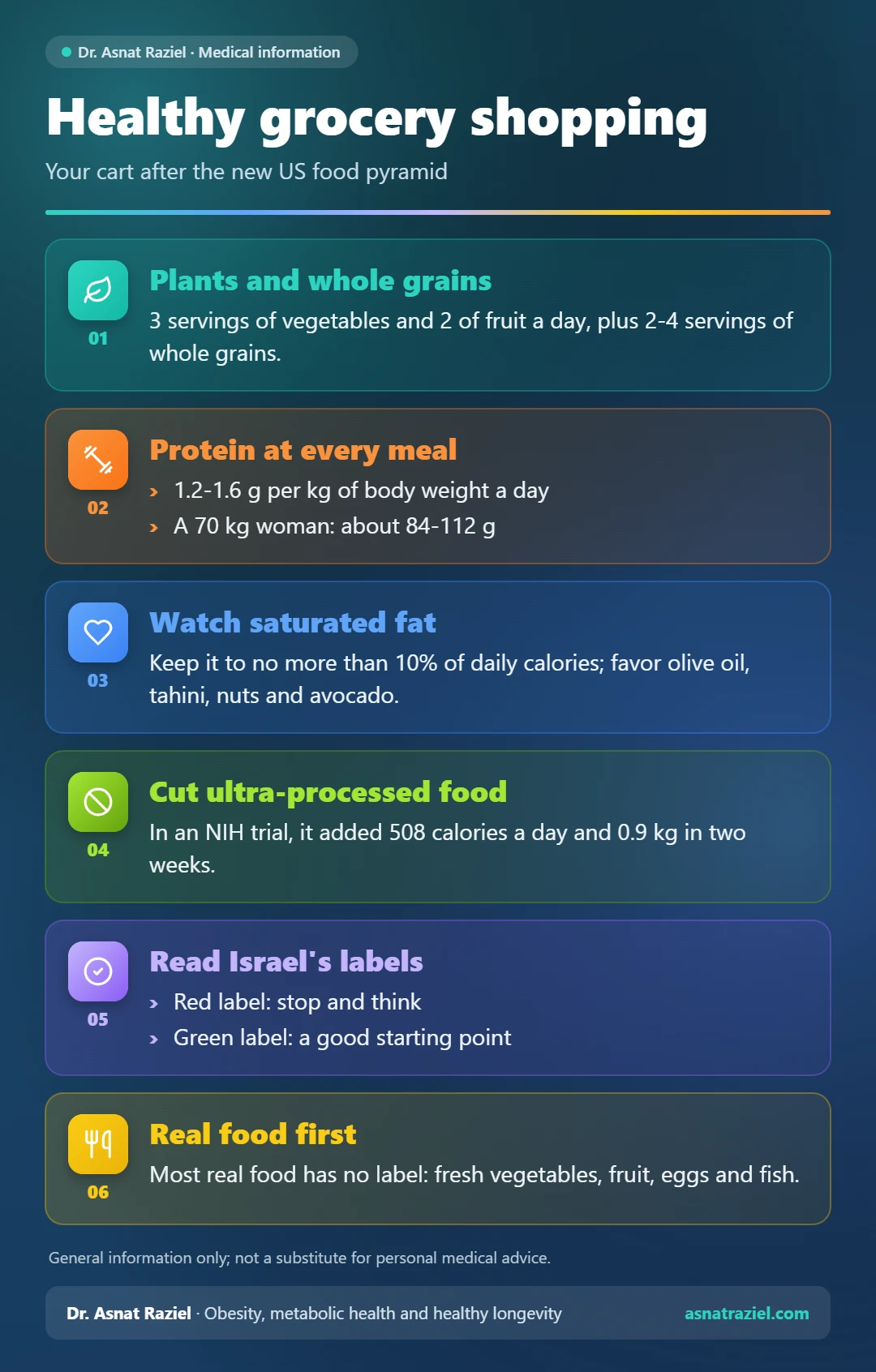
Healthy grocery shopping in seven steps
- First, vegetables: fill half the cart with fresh and frozen vegetables, without ready-made sauces.
- Second, whole fruit instead of juices and sweetened drinks.
- In addition, protein for every meal: eggs, fish, chicken, legumes, tofu and plain yogurt.
- Also, whole grains instead of white ones: oats, buckwheat, brown rice and whole-wheat bread.
- As for fat, choose olive oil, raw tahini, nuts and avocado.
- Before a product goes into the cart, read the label: few ingredients, no added sugar and no red label.
- Finally, water and sugar-free drinks instead of sweet beverages.
Will the guidelines change the shelves?
The US guidelines are not a law that binds consumers. Even so, they influence government food programs and the food industry. Moreover, consumers themselves have been looking for fresh, protein-rich food in recent years. So the guidelines will likely reinforce an existing trend rather than spark an immediate revolution in prices. This trend matters for healthy grocery shopping, because the link between fast food and obesity keeps growing stronger.
Bottom line: healthy grocery shopping is not a diet
A healthy grocery cart is not a weight-loss menu. It is a way to buy food that fills you up, nourishes you and protects your health for years. The new guidelines remind us of an old principle: as little processed food as possible, as much real food as possible. Ultimately, people dealing with excess weight, prediabetes or fatty liver will benefit from personal nutrition guidance. That kind of guidance also helps with improving insulin sensitivity through diet.
The information in this article is general and does not replace personal medical advice.
References
Dietary Guidelines for Americans, 2025-2030
Updated Dietary Guidelines Emphasize Protein, Full-Fat Dairy, and Limits on Ultra-Processed Foods
New U.S. nutrition guidance emphasizes importance of healthier eating
Development of Criteria for a Positive Front-of-Package Food Labeling: The Israeli Case




