By Dr. Asnat Raziel, bariatric surgeon specializing in obesity treatment, metabolic health and healthy longevity; Director of the Multidisciplinary Center for Obesity Treatment, Assia Medical, Assuta Ramat HaChayal, Tel Aviv
Future obesity drugs at ObesityWeek
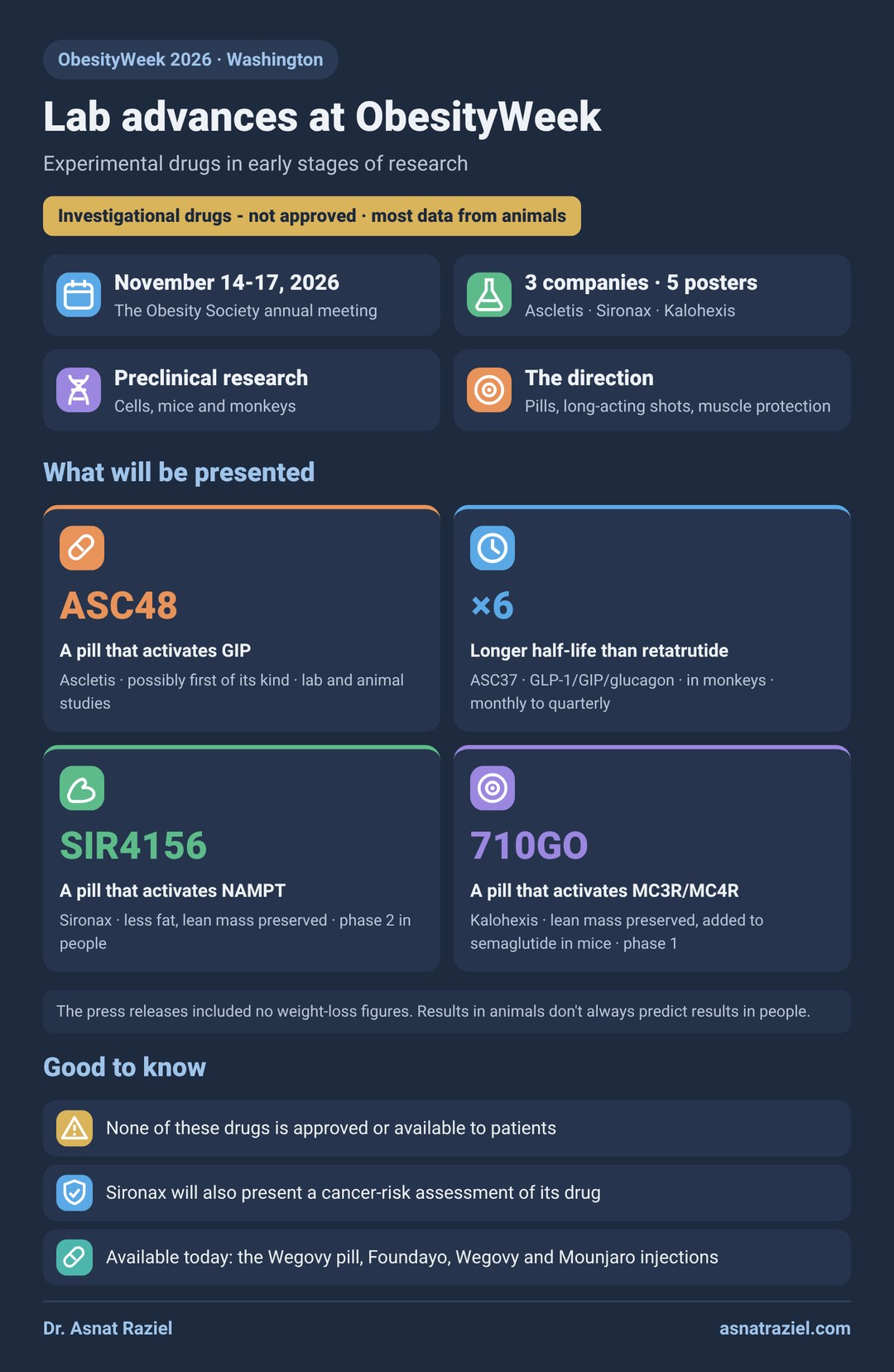
Future obesity drugs begin their journey in the lab, long before they reach patients. At ObesityWeek, the American obesity meeting in Washington, three biotech companies will present early data on new drugs. Most of the data come from studies in mice and monkeys. That means none of these drugs is approved, and none will reach pharmacies soon. Still, they show where research is heading: pills instead of injections, a shot once a month or even once a quarter, and protecting muscle during weight loss.
What is preclinical research?
Preclinical research is the stage of testing that comes before trials in people. At this stage, researchers test a drug in cells in the lab and in animals – for example, mice that became obese on a high-fat diet (DIO, diet-induced obesity). The results matter, but they promise nothing. As one of the companies writes in its announcement, results in animals don’t always predict results in people.
The annual meeting of The Obesity Society runs from November 14 to 17, 2026. All the posters described here will be presented on the opening evening, November 14.
Ascletis: a GIP pill and a long-acting triple shot
The Chinese company Ascletis will present two posters. The first covers ASC48, a pill that activates the receptor for the hormone GIP. According to the company, it may be the first pill of its kind. GIP is a gut hormone involved in regulating blood sugar and fullness. I wrote about these hormones in the physiology of fullness. The poster will present lab and animal studies, but the announcement gave no numbers.
The second poster covers ASC37, a triple drug that activates three receptors: GLP-1, GIP and glucagon. This is the same principle as Lilly’s retatrutide. According to the poster’s title, ASC37’s half-life in monkeys is six times longer than retatrutide’s. It also led to marked weight loss in obese mice. The company is developing it as a shot given once a month to once a quarter, as well as a once-weekly pill.
Future obesity drugs that target muscle
One of the biggest concerns with obesity medication is the loss of muscle mass. That is why some companies are looking for ways to cut fat while protecting muscle.
Sironax: a NAMPT activator and the cell’s energy supply
Sironax will present two abstracts on SIR4156, a pill that activates the enzyme NAMPT. This enzyme makes the molecule NAD+ inside cells, and NAD+ helps the cell produce energy. NAD+ levels fall with age and in metabolic disease, which is why they also interest the longevity field. According to the company, in preclinical models the drug led to preferential fat loss while preserving lean body mass. It also reduced muscle wasting and improved physical performance.
The first poster will show better metabolism and weight loss in obese mice. The second will present a cancer-risk assessment, an important question for any drug that affects the cell’s energy supply. The announcement gave no numbers. Beyond that, the company is already testing the drug in people, in a phase 2 trial called FORGE-LM.
Kalohexis: switching on the melanocortin system
Kalohexis will present a poster on 710GO, a pill that activates two receptors in the brain: MC3R and MC4R. These receptors are part of the melanocortin system, which regulates appetite and energy expenditure. It’s worth knowing that another drug acting on MC4R is already used to treat a rare genetic form of obesity that comes with hyperphagia – extreme, relentless hunger.
According to the poster’s title, in obese mice the drug led to weight loss while preserving lean mass, and it increased energy expenditure. What’s more, it boosted the weight loss achieved with semaglutide. The announcement included no numbers. Meanwhile, 710GO is now being tested in a phase 1 trial in people.
Future obesity drugs: what it means for you
First, none of these drugs is available today, and some may never arrive. Of the many drugs tested in animals, only a few ever reach approval. On the other hand, the directions themselves are encouraging. In the future, we may be able to combine a drug that curbs appetite with one that protects muscle.
In the meantime, existing treatments already work very well. For example, Foundayo and the Wegovy pill are available today. In addition, retatrutide is now in advanced stages of research. Novo Nordisk will also present new data at the meeting, as I describe in what Novo will present at ObesityWeek.
The bottom line
At ObesityWeek in Washington, researchers will present several new directions in obesity treatment: a pill that activates GIP, a triple shot that might be given once a quarter, and pills aimed at protecting muscle. For now, all the data come from animals, so it’s too early to draw conclusions. In the end, only studies in people will tell us whether these really are future obesity drugs.
This article is general information only and is not personal medical advice. Talk to your doctor before making any change to your treatment.
References
Kalohexis Announces Poster Presentation at ObesityWeek® 2026 Annual Meeting
This article is based on the developers’ press releases.




