By Dr. Asnat Raziel, bariatric surgeon specializing in obesity treatment, metabolic health and healthy longevity; Director of the Multidisciplinary Center for Obesity Treatment, Assia Medical, Assuta Ramat HaChayal, Tel Aviv
Exercising but not losing weight? It’s not just you
“I’m exercising but not losing weight” is one of the things I hear most often in my clinic. People put in hours at the gym, and yet the scale barely moves. The frustration is understandable, but in most cases this is not a personal failure. There is a clear physiological explanation, and there are also practical ways to change the picture.
What research says about exercise and weight loss
Physical activity is very important for health. On its own, however, it usually leads to only modest weight loss. The American College of Sports Medicine (ACSM) position stand states that 150 to 250 minutes a week of moderate-intensity activity leads to only a small weight loss. Significant weight loss was seen only above 250 minutes a week, or when combined with dietary changes. In other words, the difficulty you’re experiencing matches what studies show.
It’s also important to keep the bigger picture in mind. Weight loss happens when, over time, the body uses more energy than it takes in. Exercise is only one side of the equation. Moreover, our bodies respond to exercise in ways that narrow this gap.
Common reasons you’re exercising but not losing weight
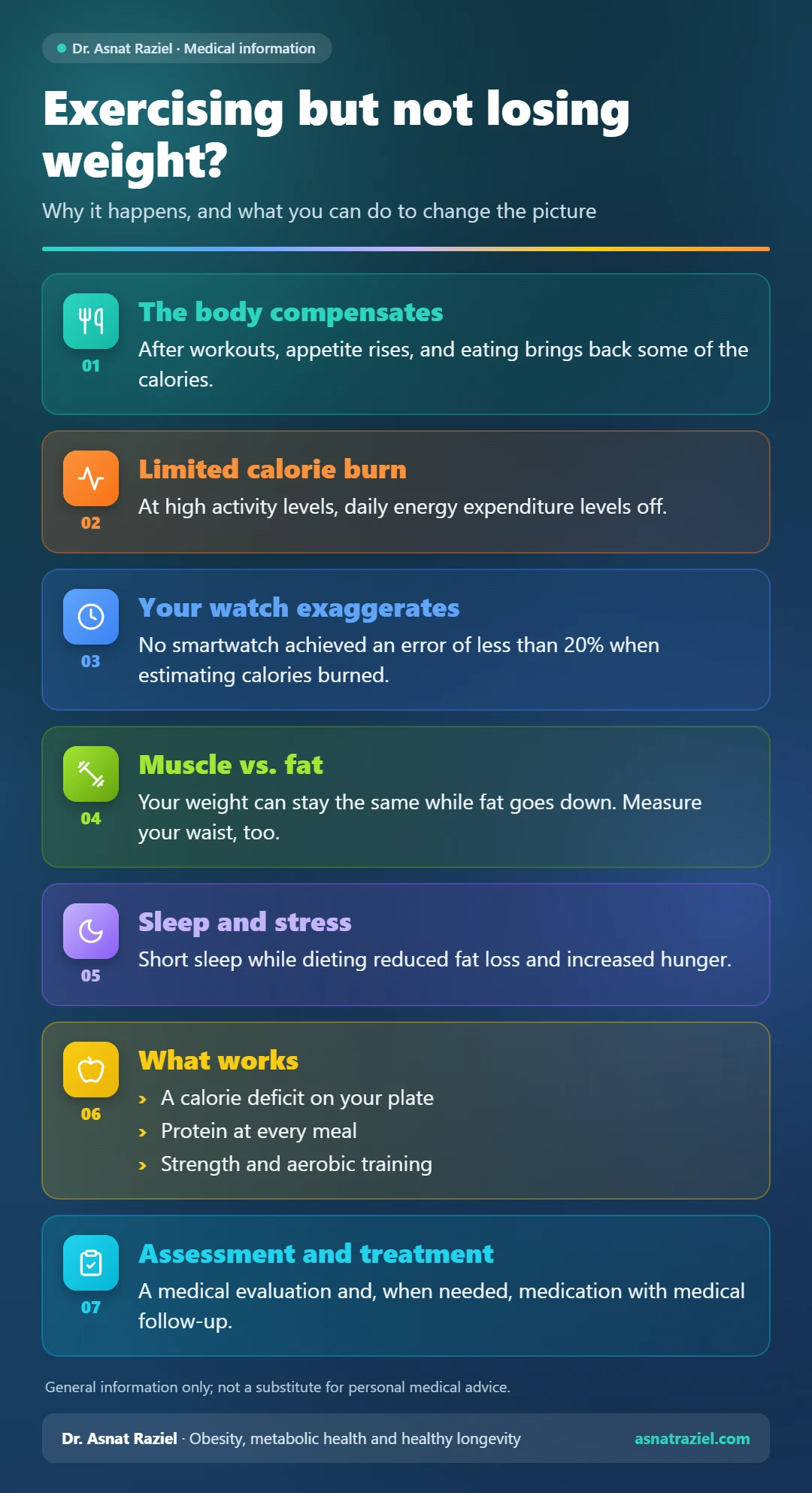
1. Your body compensates through appetite
The E-MECHANIC trial included 198 adults with overweight or obesity. They exercised under supervision for 24 weeks, at two different doses. Participants lost less weight than the researchers expected. In other words, the body “compensated” for the exercise. This compensation reached about 1.5 kg in the low-dose group and about 2.7 kg in the high-dose group. The main reason was eating more, by about 90 to 124 calories a day on average. In addition, those who compensated more reported a bigger appetite and cravings for sweets.
2. Energy expenditure doesn’t rise forever
A study by Herman Pontzer and colleagues measured daily energy expenditure in 332 adults from five populations. At low activity levels, every bit of extra movement increased daily expenditure. At high activity levels, by contrast, total expenditure leveled off. The researchers explain that the body adapts and keeps energy expenditure within a narrow range. Therefore, doubling your workouts does not double the calories you burn.
3. Your smartwatch exaggerates
A Stanford University study tested seven popular watches and fitness trackers. Most of them measured heart rate reasonably well. On the other hand, none of them achieved an error of less than 20% when estimating calories burned. If you eat “back” what your watch shows, it’s very easy to cancel out your deficit. For realistic figures, it’s worth learning how many calories different workouts actually burn.
4. Muscle goes up, fat goes down
Strength training builds muscle mass. In that case, your weight may stay the same even as your body fat percentage drops. The ACSM notes that strength training does not boost weight loss. Even so, it increases lean body mass and reduces health risks. That is why measuring your waist or your body composition sometimes tells a more accurate story than the scale.
5. Short sleep and stress
Sleep directly affects your results. In a small trial of 10 adults on a two-week diet, sleeping 5.5 hours instead of 8.5 changed the makeup of the weight they lost. Participants lost 0.6 kg of fat instead of 1.4 kg. At the same time, they lost 2.4 kg of lean mass instead of 1.5 kg. They also reported more hunger. Chronic stress increases appetite as well, so the link between stress and obesity is relevant here.
6. A plateau after initial weight loss
Sometimes the weight comes off at first and then stalls. This is a natural process, because a lighter body burns less energy. I have written more about this in my article on weight-loss plateaus. If your attempts keep repeating themselves, it’s also worth reading about weight-loss failure and the factors behind it.
When exercising but not losing weight calls for a medical checkup
Sometimes a medical cause makes weight loss harder. Examples include an underactive thyroid, insulin resistance or polycystic ovary syndrome (PCOS). Certain medications, such as some psychiatric drugs or steroids, can also cause weight gain. In such cases, a simple blood test and a conversation with your doctor can save months of frustration.
Exercising but not losing weight: what actually works
- Nutrition first: a calorie deficit is created mainly on your plate. Combining nutrition and exercise is what makes the difference.
- Protein at every meal: it’s filling and helps preserve muscle.
- Strength training two to three times a week, alongside aerobic activity. Short exercise snacks during the day also help.
- Movement throughout the day: walking, taking the stairs and sitting less.
- At least seven hours of sleep a night.
- Smart tracking: your waist size, your clothes and how you feel, not just the scale.
In addition, set regular times for workouts and meals. A predictable routine makes it easier to stick with your plan and reduces unplanned eating after workouts.
Exercising but not losing weight: when to consider medication
In people with obesity, the body defends its weight very strongly. In this situation, adding medication can help. GLP-1 medications reduce appetite and thus directly address the compensation mechanism I described. However, they are suitable only when there is a medical indication and with medical follow-up. You’ll find detailed information on my page about medications for obesity. Even during treatment, exercise remains important for preserving muscle mass.
The bottom line
If “I’m exercising but not losing weight” sounds familiar, don’t give up on exercise. It improves your heart, muscles and mood, as well as your chances of keeping the weight off in the long run. Still, weight loss itself depends mainly on nutrition, sleep and sometimes medical treatment. A healthy lifestyle is the foundation, and if it isn’t enough, consider consulting a doctor who specializes in obesity. You can find more information about Dr. Asnat Raziel and the center on this site.
The information in this article is general information only and is not a substitute for personal medical advice.
Questions and answers
I’ve been exercising but not losing weight for a month. Is that normal?
Yes, it happens to many people. In the first month, changes in fluids and muscle sometimes mask fat loss. It’s a good idea to measure your waist, too, and to take a look at your diet.
Should I exercise more?
Not necessarily. Beyond a certain level, the body adapts and appetite increases. It’s usually better to improve your diet and sleep than to add more hours of training.
Which is better, aerobic or strength training?
The combination is best. Aerobic exercise benefits heart health, while strength training preserves muscle mass, especially during weight loss.
When should I see a doctor?
See a doctor if you have unexplained weight gain, extreme fatigue or other symptoms. Likewise, if several months of effort bring no results, a medical evaluation can help.
Sources
Constrained Total Energy Expenditure and Metabolic Adaptation to Physical Activity in Adult Humans
Insufficient sleep undermines dietary efforts to reduce adiposity




