By Dr. Asnat Raziel, bariatric surgeon specializing in obesity treatment, metabolic health and healthy longevity; Director of the Multidisciplinary Center for Obesity Treatment, Assia Medical, Assuta Ramat HaChayal, Tel Aviv
GLP-1 after heart attack: beyond weight loss
Can GLP-1 after a heart attack protect the heart muscle? Drugs in the GLP-1 family were first developed to treat type 2 diabetes. Later, it turned out that they are also highly effective for treating obesity. Now a new study suggests that their effects reach much further.
In March 2026, a study in the journal Nature Communications proposed a fascinating biological mechanism. According to the study, the hormone GLP-1 does more than reduce appetite and improve metabolism. It may also protect the heart after a heart attack, by acting on the tiny blood vessels in the heart muscle. One thing is important to know right away: the study was done in animals and has not yet been tested in humans.
The hidden problem: the no-reflow phenomenon
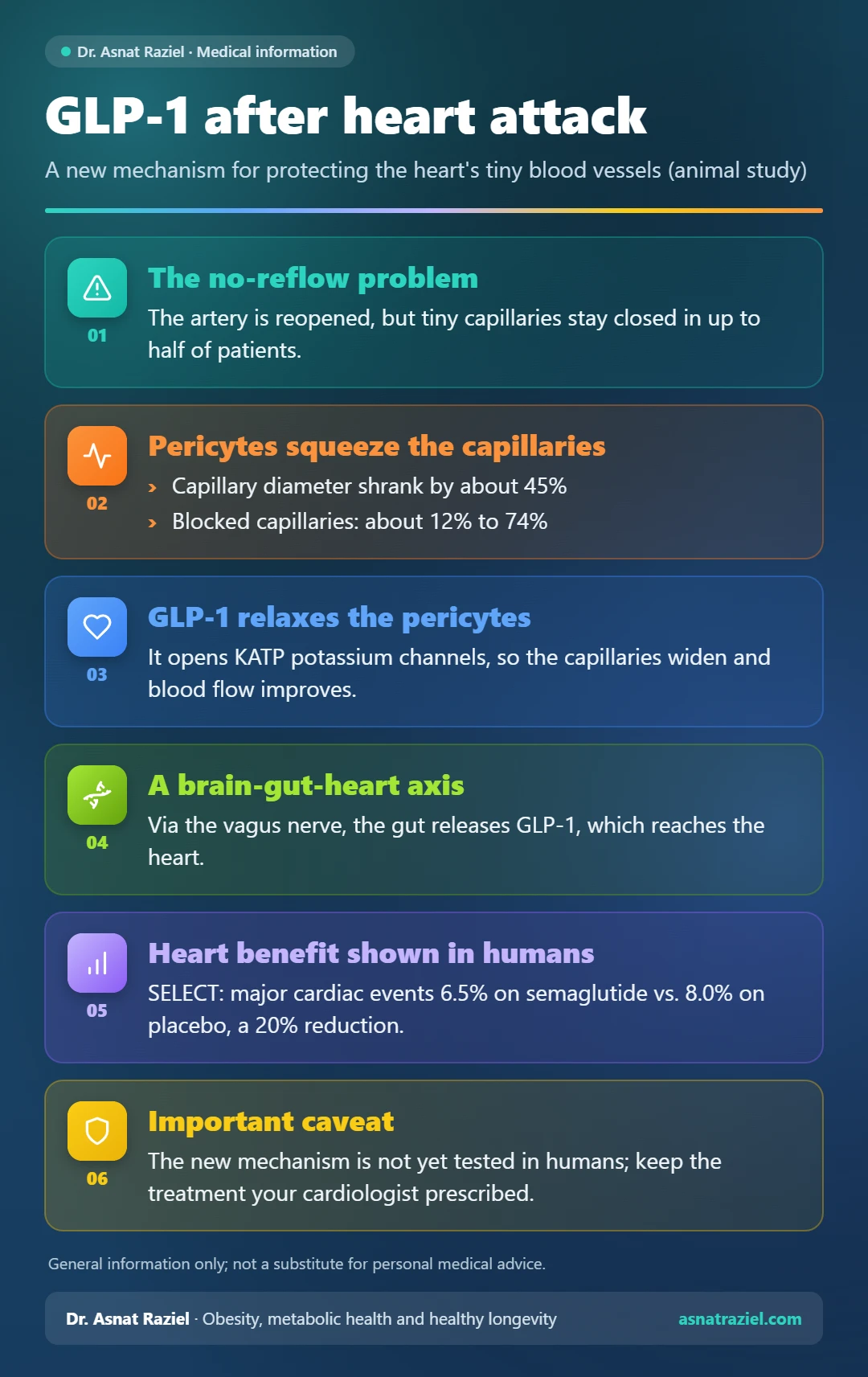
When someone has a heart attack, the main treatment is to open the blocked artery with an emergency catheterization (PCI). The procedure restores blood flow in the large artery. However, in many cases the blood does not properly reach the smallest blood vessels inside the heart muscle. Doctors call this phenomenon “no-reflow.”
The main artery is open, but the tiny capillaries stay closed. As a result, parts of the heart muscle do not get oxygen. According to the researchers, the phenomenon affects up to half of patients after the artery is opened. It is linked to serious outcomes:
- Reduced heart function.
- A much larger infarct (area of damaged heart muscle).
- A high risk of heart failure.
- Higher mortality.
For this reason, understanding blockage in the tiny blood vessels is one of the great challenges of modern cardiology.
What closes the tiny blood vessels?
Specifically, the study focused on special cells called pericytes. These cells wrap around the smallest capillaries in the body. They can also contract and relax, and in this way they control the diameter of the capillaries.
During ischemia, that is, a lack of oxygen, the pericytes contract and narrow the capillaries. Often, this contraction continues even after the main artery has been opened. The result is a blockage of the capillaries themselves and reduced blood flow to the heart.
In experiments on rodent hearts, the researchers measured the damage after ischemia:
- Capillary diameter at the pericytes shrank by about 45%.
- The share of blocked capillaries rose from about 12% to about 74%.
Thus, these numbers show how much pericyte contraction harms the blood supply to the heart muscle.
How GLP-1 works after a heart attack
The researchers found that the hormone GLP-1 relaxes the pericytes and reopens the capillaries. According to the University of Bristol, they used exendin-4, a substance from the same family as Ozempic. The mechanism works in stages:
- GLP-1 binds to receptors on the surface of the pericytes.
- This binding opens special potassium channels called KATP channels.
- Potassium leaves the cell, and the cell becomes hyperpolarized.
- Less calcium enters the cell.
- The pericytes relax, and the capillaries widen.
In this way, blood flow through the heart muscle’s tiny vessels improves. Moreover, when the researchers blocked the KATP channels or removed them genetically, the protection disappeared.
A new axis in the body: brain, gut and heart
One of the most intriguing findings is a communication pathway between distant organs. When one organ, such as a limb muscle, experiences ischemia, the body activates a nerve pathway through the vagus nerve. In response, the gut releases GLP-1, and the hormone travels through the blood to the heart.
This creates a communication axis: brain → gut → heart. The researchers call it the brain-gut-heart signalling pathway. This axis switches on a natural mechanism that protects the heart muscle.
What we know about GLP-1 after a heart attack in humans
Large studies have already shown that GLP-1 drugs reduce cardiac events. For example, the SELECT trial included 17,604 people with heart disease and overweight or obesity, without diabetes. A major cardiac event occurred in 6.5% of patients on semaglutide, compared with 8.0% on placebo. That is a 20% reduction in risk. You can read more in my article on Wegovy and heart protection.
In addition, there are early data from the first hours after a heart attack. In a Danish study, 172 patients received intravenous exenatide or placebo during catheterization. Among patients who received the drug, the treatment saved a large part of the muscle at risk. However, there was no difference in heart function or in clinical events after 30 days.
Until now, it was not entirely clear how these drugs protect the heart. The new study offers a possible biological explanation. The drugs do not only lower weight, blood sugar and inflammation. They may also improve blood flow through the heart’s tiny vessels after ischemia. If so, the possible results are a smaller infarct, better heart function and better survival.
An important caveat
Experts warn against jumping to conclusions. Prof. Bryan Williams of the British Heart Foundation noted that the findings require detailed studies in humans and clinical trials. In other words, there is currently no recommendation to give GLP-1 as an emergency treatment for a heart attack. If you have had a heart attack, continue the treatment your cardiologist prescribed.
What this means for patients today
For people living with obesity and heart disease, the practical message is clear. GLP-1 drugs are already proven to reduce cardiac events, regardless of the new mechanism. So it is worth talking with your physician about whether such treatment suits you. It is also important to combine it with good nutrition, physical activity and cardiology follow-up. For a comparison of the options, see my article on Mounjaro and heart disease prevention.
Future implications: targeted drugs
Existing GLP-1 drugs act on many systems in the body. In the future, therefore, researchers may develop drugs that act directly on the pericytes in the heart. Such drugs could open blocked capillaries, prevent no-reflow and improve the results of catheterization. Consequently, this approach could open the door to a new generation of treatments in cardiology.
The bottom line on GLP-1 after heart attack
For years, GLP-1 drugs were seen mainly as a tool for treating diabetes and obesity. Today the picture is much broader: better metabolism, reduced chronic inflammation and protection of the heart and blood vessels. The research on GLP-1 after a heart attack adds an important layer to our understanding of these protective mechanisms. Ultimately, it shows how the body works as a network of communication between organs. For more on the link between weight and the heart, read about obesity and heart disease and about semaglutide and the heart.
This article provides general information and is not a substitute for personal medical advice.
References
GLP-1 drugs like Ozempic could cut risk of major heart complications after heart attack, study finds
Semaglutide and Cardiovascular Outcomes in Obesity without Diabetes
Exenatide reduces reperfusion injury in patients with ST-segment elevation myocardial infarction
The Nature Communications study was funded in part by the British Heart Foundation (BHF). The SELECT trial was funded by Novo Nordisk.




