By Dr. Asnat Raziel, bariatric surgeon specializing in obesity treatment, metabolic health and healthy longevity; Director of the Multidisciplinary Center for Obesity Treatment, Assia Medical, Assuta Ramat HaChayal, Tel Aviv
Insulin resistance: the link between obesity and diabetes
Insulin resistance is the link that connects obesity and type 2 diabetes. These two conditions are not just common. In fact, they are part of the same metabolic system. For years, medicine saw them as two separate diseases. Today, however, we understand that they are two expressions of the same deep biological process. The good news is that we can stop this process before diabetes sets in.
When the body accumulates excess fat, especially around the abdomen, many metabolic changes begin. Fat tissue is not just an energy store. Rather, it acts as an active organ that releases hormones, inflammatory substances and signaling molecules. In turn, these substances affect the liver, the muscles and the pancreas.
How insulin resistance develops
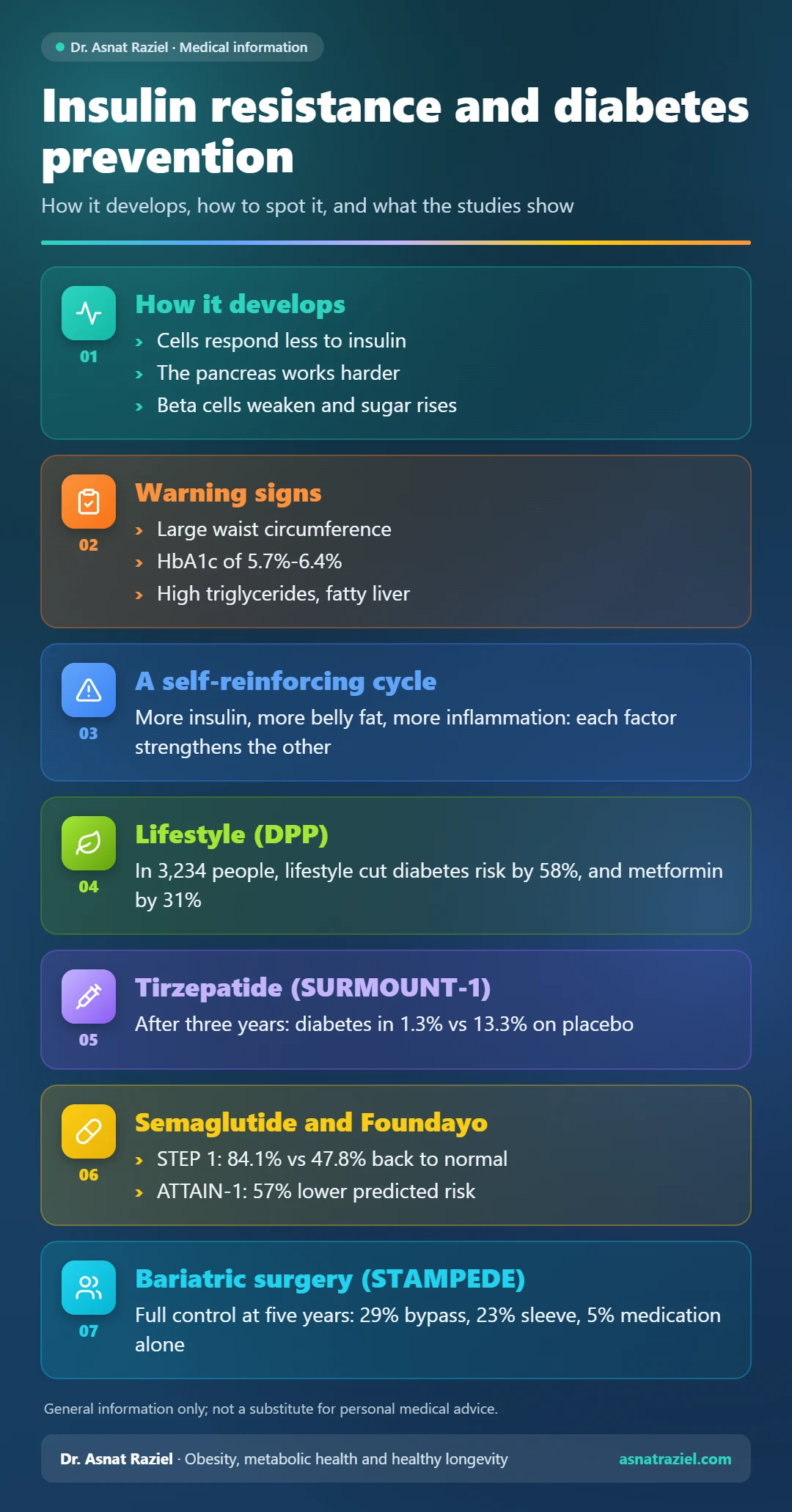
Over time, the body’s cells respond less and less to insulin. As a result, they struggle to take up sugar from the blood. In response, the pancreas releases large amounts of insulin to overcome the problem.
Early on, this compensation works, and blood sugar levels stay relatively normal. But as the resistance worsens, the pancreas finds it harder to keep up. The beta cells, which produce insulin, gradually weaken. At this stage blood sugar levels rise, and type 2 diabetes develops. The stage just before that is called prediabetes, and it is the biggest window of opportunity for treatment.
Maccabi’s medical review of prediabetes (in Hebrew) describes the same process. As cells respond less to insulin, the pancreas must produce more of it, until the beta cells wear out.
How to recognize insulin resistance
In most cases, this condition causes no symptoms. Even so, there are signs worth knowing. For example, a large waist circumference is the most obvious one. Blood tests may show high fasting glucose, an HbA1c (average blood sugar over the past three months) in the 5.7%-6.4% range, and high triglycerides. Fatty liver, high blood pressure and dark patches in the skin folds of the neck can also point to the problem. In such cases, it is a good idea to get checked. For practical next steps, see my article on improving metabolic markers.
Belly fat: a key driver
One of the major factors in this process is visceral fat, the fat surrounding the internal abdominal organs. This fat is highly active metabolically and releases many inflammatory substances. These substances reduce the cells’ sensitivity to insulin and increase sugar production in the liver. They also disrupt the body’s hormonal balance.
The end result is chronic low-grade inflammation. Usually you don’t feel it, but it plays a central role in diabetes, heart disease and other metabolic diseases. You can read more in my article on visceral fat.
The body works as a communication network
Metabolism does not run through a single organ. Instead, it is a network of communication between several key organs. First, the liver produces sugar and releases it into the blood. Then the muscles take up sugar after meals and use it for energy. Meanwhile, the pancreas regulates blood sugar with insulin, and fat tissue sends signals that affect the entire system.
When obesity upsets the balance between these organs, it causes a broad disruption of metabolism. This disruption is the foundation on which type 2 diabetes develops.
Insulin resistance as a self-reinforcing cycle
The link between obesity and diabetes often works as a cycle that feeds itself. As insulin resistance rises, the body releases more insulin. High insulin levels encourage more fat storage, mainly in the abdomen. Belly fat increases inflammation, which in turn worsens the resistance again. In this way, each factor strengthens the other. That is why obesity sharply raises the risk of type 2 diabetes.
The treatment that prevents diabetes: what the studies show
Understanding this link has led to a change in the medical approach. Instead of focusing only on blood sugar control, modern medicine also treats obesity itself. And the studies show that this works.
Lifestyle: the foundation
Lifestyle change, including a balanced diet, physical activity and good-quality sleep, is the foundation. The American DPP study included 3,234 people with elevated blood sugar. A lifestyle program reduced the risk of diabetes by 58%. By comparison, the drug metformin reduced it by 31%. Diet also plays an important role in improving insulin sensitivity.
The new medications
In recent years, incretin-based medications have entered the picture. They act on the GLP-1 and GIP receptors. Moreover, these drugs improve blood sugar control, reduce appetite and support weight loss. For example, the SURMOUNT-1 trial followed 1,032 people with obesity and prediabetes. After three years on tirzepatide (Mounjaro/Zepbound), only 1.3% of them developed diabetes, compared with 13.3% on placebo. In other words, the risk of diabetes dropped dramatically.
Similarly, an analysis of the STEP trials looked at semaglutide (Wegovy). In STEP 1, 84.1% of participants with prediabetes returned to normal blood sugar levels, compared with 47.8% on placebo. In addition, an analysis of the ATTAIN-1 trial examined the Foundayo pill (orforglipron). At the highest dose, the predicted risk of diabetes over the next ten years fell by 57% compared with placebo. To be precise, this is a model-based estimate, not a count of actual diabetes cases. You can learn more in my article on Foundayo and diabetes prevention.
Bariatric surgery
In some cases, bariatric surgery is an important treatment tool. The STAMPEDE trial included 150 patients with diabetes. After five years, 29% of gastric bypass patients and 23% of sleeve gastrectomy patients reached full blood sugar control. In contrast, only 5% of those treated with medication alone achieved that level of control.
Looking ahead: personalized treatment
Research on metabolic diseases is moving fast. Scientists are working to understand the mechanisms behind obesity and diabetes much better. For instance, one major direction is identifying subtypes of metabolic disease. In the future, this knowledge may allow us to tailor treatment to each patient.
The bottom line on insulin resistance
The message is clear. Obesity is not a cosmetic problem, but a metabolic disease that affects many systems in the body. Insulin resistance begins years before diabetes is diagnosed. Therefore, early and appropriate treatment can break the cycle. Ultimately, combining lifestyle, the right medications and sometimes surgery makes it possible to prevent diabetes and other diseases. If you have signs of insulin resistance or prediabetes, it is worth getting evaluated and treated now.
This article provides general information and is not a substitute for personal medical advice.
References
Reduction in the incidence of type 2 diabetes with lifestyle intervention or metformin
Tirzepatide for Obesity Treatment and Diabetes Prevention
Bariatric Surgery versus Intensive Medical Therapy for Diabetes – 5-Year Outcomes
The SURMOUNT-1 and ATTAIN-1 trials were funded by Eli Lilly, and the STEP trials by Novo Nordisk.