By Dr. Asnat Raziel, bariatric surgeon specializing in obesity treatment, metabolic health and healthy longevity; Director of the Multidisciplinary Center for Obesity Treatment, Assia Medical, Assuta Ramat HaChayal, Tel Aviv
The SCORE study: does heart protection hold up in everyday practice?
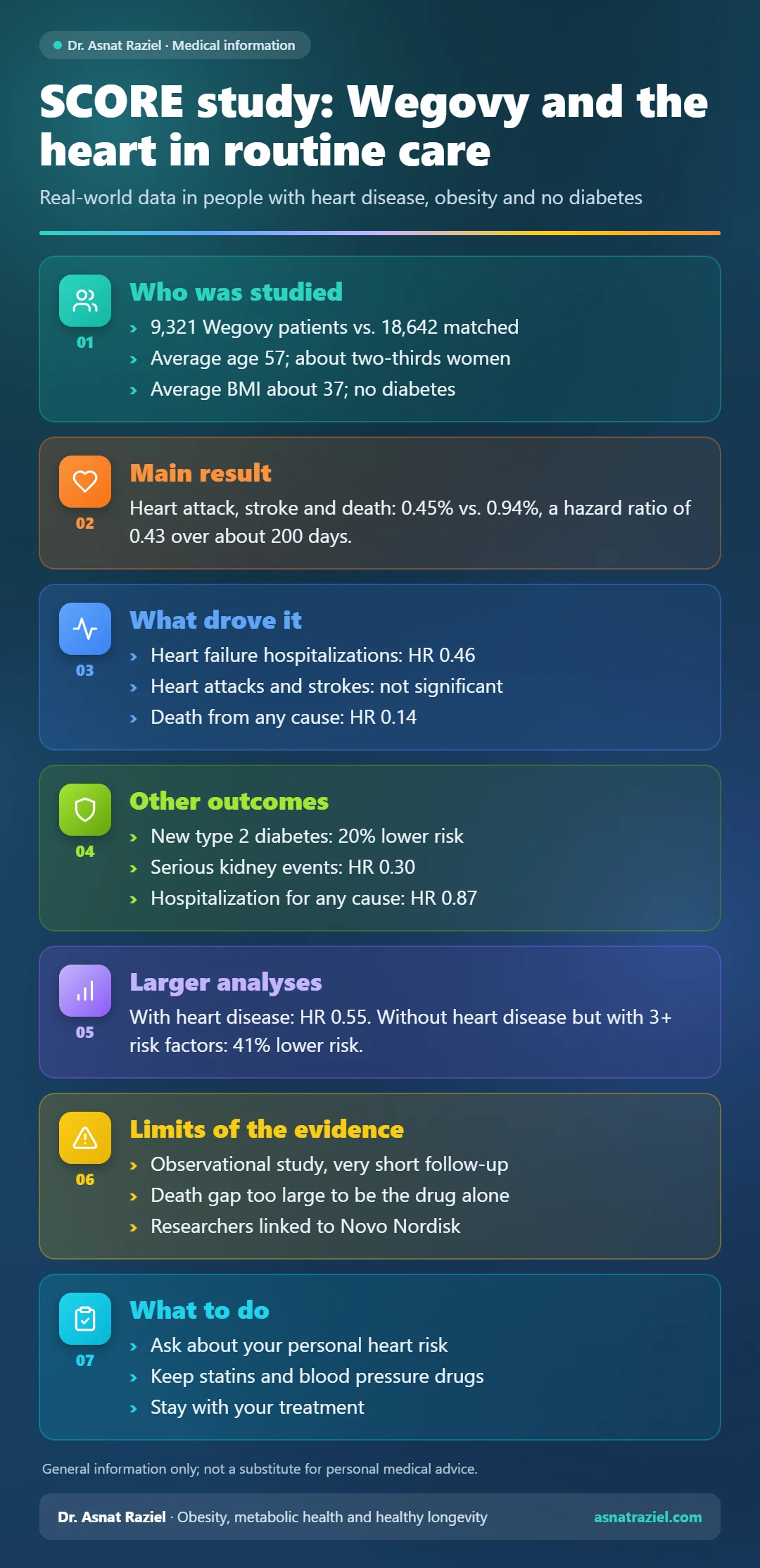
The SCORE study asked whether the heart protection that Wegovy showed in a controlled trial also appears in routine care. The researchers compared about 9,300 patients with heart disease, obesity and no diabetes with twice as many similar patients who did not receive the drug. Among Wegovy patients, the risk of major heart events was roughly half. However, this is a short observational study, and it is important to understand its limits.
Background: what the SELECT trial already proved
Wegovy contains semaglutide at a weekly dose of 2.4 mg. The SELECT trial enrolled 17,604 people with existing heart disease, overweight or obesity, and no diabetes. Compared with placebo, treatment lowered the risk of heart attack, stroke and death from heart disease by 20%. As a result, the US Food and Drug Administration (FDA) approved Wegovy to lower cardiovascular risk in this population. I covered this in more detail in my article Wegovy protects the heart.
In a controlled trial, though, researchers select patients carefully and follow them closely. That is why it matters to check what happens in everyday practice. This is exactly the goal of real-world evidence studies, which use data from routine treatment outside clinical trials. For a real-world comparison with Mounjaro, see my article on the STEER study.
What the SCORE study examined
The researchers used Komodo, a US database that pools insurance data and medical records. They included adults aged 45 and older with overweight or obesity. Every participant had a previous heart attack or stroke, or had peripheral artery disease. On the other hand, the researchers excluded people with diabetes.
In total, 9,321 patients started Wegovy. For each of them, the researchers matched two similar patients who did not receive the drug, for a total of 18,642 people. The matching took into account age, sex, weight, other medical conditions and medications. The average age was 57, and about two-thirds were women. The average BMI was about 37.
Key terms to know
MACE stands for major adverse cardiovascular events. The study’s main measure included heart attack, stroke and death from any cause. A broader measure also included hospitalization for heart failure and catheter procedures or surgery to open the heart arteries. The hazard ratio (HR) compares the rate of events between the groups. For example, a value of 0.6 means a risk about 40% lower.
SCORE study: the main results
Average follow-up lasted about 200 days, or roughly six months. Here are the key findings for Wegovy compared with no treatment:
- Heart attack, stroke and death from any cause: 0.45% versus 0.94%. The hazard ratio was 0.43.
- The broader measure, including heart failure and artery procedures: 0.94% versus 1.55%. The hazard ratio was 0.55.
- When the researchers looked at death from heart disease instead of death from any cause, the hazard ratios were 0.58 and 0.65.
In other words, under every definition, Wegovy patients had fewer major heart events. All of these differences were statistically significant.
What drove the difference
Here it is important to look at each component separately. Hospitalizations for heart failure fell by about half (hazard ratio 0.46). By contrast, the drop in heart attacks and strokes did not reach statistical significance. In addition, the researchers found no difference in artery procedures.
Surprisingly, the largest gap appeared in deaths. Death from any cause had a hazard ratio of 0.14, and death from heart disease had a hazard ratio of 0.27. These effects are far larger than those in the SELECT trial. Therefore, part of the gap probably reflects hidden differences between the groups, and not only the drug. For example, people who start a new treatment tend to be in relatively good health.
Additional findings: diabetes, kidneys and obesity complications
The researchers also looked at other outcomes, as an exploratory analysis:
- New type 2 diabetes: a 20% lower risk (hazard ratio 0.80).
- Serious kidney events: a hazard ratio of 0.30, mainly because of fewer episodes of acute kidney injury.
- Serious obesity-related complications: a hazard ratio of 0.84.
- Hospitalization for any cause: a hazard ratio of 0.87.
I wrote about the links between the heart, the kidneys and metabolism in my article on CKM syndrome.
The SCORE study expands: larger populations
After the first analysis, the researchers extended the SCORE study to more populations. A broad analysis of patients with heart disease included 38,308 Wegovy patients and 76,615 patients without the treatment. Over about 8.6 months of follow-up, the hazard ratio for major heart events was 0.55.
Another analysis, published in the American Journal of Preventive Cardiology, looked at people without heart disease but with at least three risk factors. These risk factors included, for example, high blood pressure, high blood lipids, prediabetes and smoking. The study included 48,184 Wegovy patients and 96,368 patients without the treatment. Over about nine months of follow-up, the risk of major heart events was 41% lower (hazard ratio 0.59). Here too, hospitalizations for heart failure fell, but the difference in heart attacks and strokes was not significant. Likewise, the gap in deaths was again especially large.
The SCORE study: limits of the evidence
This is an observational study, so it shows an association, not necessarily cause and effect. First, even after careful matching, hidden differences between the groups may remain. The researchers tested this with a control outcome, hearing loss, and found no difference. Still, a check like this does not rule out the problem completely.
Second, follow-up was very short. Third, insurance data can contain recording errors, and the records note the date of death only by month. Finally, the researchers work for or consult for Novo Nordisk, the maker of Wegovy. So the findings support SELECT, but they do not replace a controlled trial. In particular, no controlled trial has yet proven heart protection in people without heart disease.
What this means for you
If you have obesity and existing heart disease, Wegovy treatment rests on a large controlled trial. Data from the SCORE study show that the picture looks similar in routine care. A few practical principles:
- Ask your doctor about your heart risk, not just your weight goal.
- Do not stop statins, blood pressure medications or blood thinners without talking to your doctor.
- Stay with your treatment. I wrote about this in my article on persistence in obesity treatment.
- Combine physical activity, a Mediterranean diet and good sleep. You can read more about the mechanisms in my article semaglutide and the heart.
Bottom line: the SCORE study
In the SCORE study, Wegovy patients with heart disease and obesity, and without diabetes, had fewer major heart events than similar untreated patients. The findings are consistent with the SELECT trial, but the differences in deaths are too large to explain by the drug alone. Ultimately, Wegovy is an important tool for protecting the heart, alongside a healthy lifestyle and existing treatments.
The information in this article is general information only and is not a substitute for personal medical advice. Before starting or changing any treatment, consult your doctor.
References
Semaglutide and Cardiovascular Outcomes in Obesity without Diabetes
The SCORE studies were conducted in collaboration with Novo Nordisk, and some of the researchers are company employees or consultants.




