By Dr. Asnat Raziel, bariatric surgeon specializing in obesity treatment, metabolic health and healthy longevity; Director of the Multidisciplinary Center for Obesity Treatment, Assia Medical, Assuta Ramat HaChayal, Tel Aviv
The STEER study: a head-to-head look at the two leading weight-loss injections
The STEER study compared Wegovy with Mounjaro for heart protection in people with obesity who do not have diabetes. The researchers followed more than 21,000 patients with established cardiovascular disease. Patients on Wegovy had a 29% lower risk of major heart events than those on Mounjaro. Moreover, among people who stayed on treatment, the gap grew even wider.
Background: two drugs, different heart evidence
Wegovy contains semaglutide, which acts on the hormone GLP-1. Mounjaro contains tirzepatide, which acts on two hormones, GLP-1 and GIP. In the United States, the same active ingredient is also sold for obesity under the name Zepbound.
Wegovy has a controlled trial that proved heart protection in people without diabetes. In the SELECT trial, Wegovy cut major heart events by 20% compared with placebo. As a result, the US Food and Drug Administration (FDA) approved Wegovy to lower cardiovascular risk in adults with heart disease and obesity. I reviewed that trial in my article Wegovy protects the heart.
By contrast, the heart outcomes trial of tirzepatide in people without diabetes is still underway. In people with diabetes, however, Mounjaro has already shown a heart benefit similar to that of an older, established drug, as I described in my article on the SURPASS-CVOT trial.
What the STEER study examined
The researchers used Komodo, a US database that pools insurance and pharmacy data. They included adults aged 45 and older with a BMI of 27 or higher. Every participant had a previous heart attack or stroke, or had peripheral artery disease. In addition, none of them had diabetes.
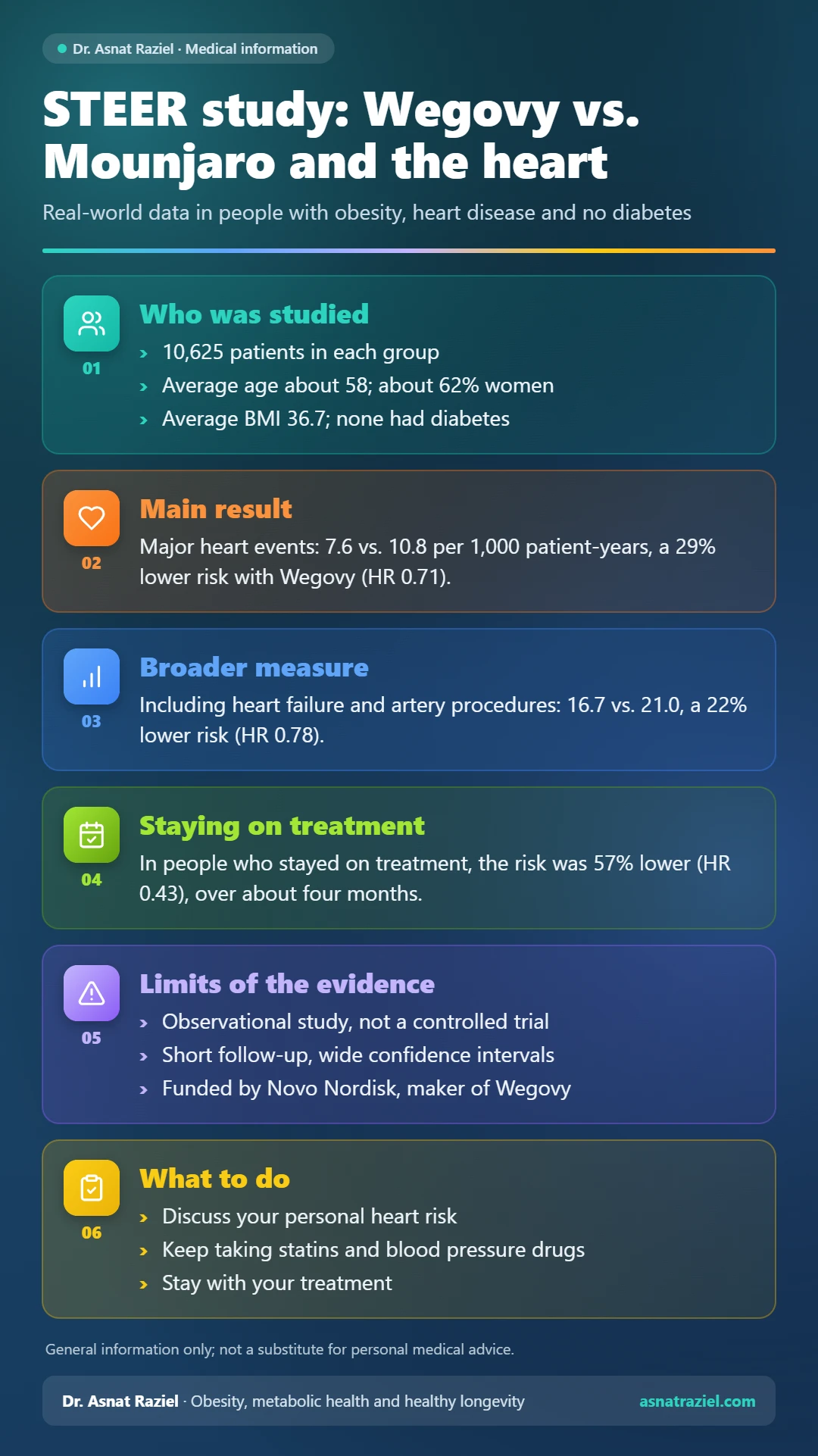
The patients started Wegovy or tirzepatide between May 2022 and January 2025. Next, the researchers matched the groups by age, sex, weight, other medical conditions and medications. In the end, each group included 10,625 patients. The average age was about 58, and about 62% were women. The average BMI was 36.7 in both groups.
Key terms to know
MACE stands for major adverse cardiovascular events. In the STEER study, the main measure included heart attack, stroke and death from any cause. A broader measure also included hospitalization for heart failure and catheter procedures or surgery to open the heart arteries. The hazard ratio (HR) compares the rate of events between the groups. Thus, a value below 1 means a lower risk in the group being studied.
STEER study: the main results
On average, the researchers followed the patients for about eight and a half months. In the main analysis, they counted each patient in the group where they started, even if they later stopped treatment. Researchers call this an intention-to-treat analysis.
- Major heart events (heart attack, stroke and death): 7.6 per 1,000 patient-years with Wegovy, compared with 10.8 with tirzepatide. The hazard ratio was 0.71, which means a 29% lower risk.
- The broader measure, including heart failure and artery procedures: 16.7 versus 21.0 per 1,000 patient-years. The hazard ratio was 0.78, which means a 22% lower risk.
In absolute numbers, 56 Wegovy patients (0.5%) and 83 tirzepatide patients (0.8%) had a major heart event. On the other hand, when the researchers examined each component on its own, none reached statistical significance. Also, the difference in death from any cause was very small.
What happens in people who stay on treatment
A second analysis looked only at the period when patients were actually taking the drug. If a patient stopped filling the prescription for more than 30 days, the analysis dropped them. Researchers call this a per-protocol analysis.
- Major heart events: 4.4 versus 10.3 per 1,000 patient-years. The hazard ratio was 0.43, which means a 57% lower risk.
- The broader measure: 12.3 versus 21.1 per 1,000 patient-years. The hazard ratio was 0.57.
- Heart attacks alone: a hazard ratio of 0.38. Hospitalization for heart failure: a hazard ratio of 0.34.
However, follow-up in this analysis was very short, about four months on average. Furthermore, the analysis recorded no deaths at all. So the number of events is small, and we should read this finding with caution. I wrote about why sticking with treatment matters in my article why success is measured over time.
The STEER study: limits of the evidence
This is an observational study, not a controlled trial. First, it shows an association, not necessarily cause and effect. Even after statistical matching, hidden differences between the groups may remain. Second, insurance data can contain recording errors. Third, the database does not record the cause of death, so the researchers used death from any cause.
What is more, many tirzepatide patients started treatment as early as 2022, while most Wegovy patients started in 2023 or later. The researchers also note that some patients received Mounjaro off-label, and some may have had undocumented diabetes. In addition, only about one in five Wegovy patients and about 7% of tirzepatide patients were on the maximum dose by the end of follow-up.
Likewise, follow-up was short and the confidence intervals were wide. For example, in the main analysis the hazard ratio ranged from 0.50 to 0.99. Finally, Novo Nordisk, the maker of Wegovy, funded the study, and all of the researchers are company employees.
It is also important to show the full picture. In another large real-world study of people with diabetes, semaglutide and tirzepatide showed a similar heart benefit. I reviewed it in my article Mounjaro and the heart in the real world. Therefore, the final answer will come only from a dedicated controlled trial.
What this means for you
If you have obesity and existing heart disease, protecting your heart is a central part of choosing treatment. Today, Wegovy has proof from a controlled trial of this benefit in people without diabetes. The STEER study findings add real-world data, but they do not replace a controlled trial. At the same time, even in the STEER study itself, tirzepatide led to greater weight loss on average, and that is also an important consideration.
A few practical principles:
- Talk with your doctor about your personal heart risk, not just your weight goal.
- Do not stop statins, blood pressure medications or blood thinners when you start obesity treatment.
- Stay with your treatment. The heart benefit builds over time.
- Combine physical activity, a Mediterranean diet and good sleep. Read more in my article on semaglutide and the heart.
Bottom line: the STEER study
In the STEER study, Wegovy patients with heart disease and obesity, and without diabetes, had fewer major heart events than tirzepatide patients. The gap appeared in the main analysis and widened among people who stayed on treatment. Still, this is a short observational study funded by the manufacturer. Ultimately, the choice of drug should be personal and should weigh the heart, the weight and the patient’s preferences.
The information in this article is general information only and is not a substitute for personal medical advice. Before starting or changing any treatment, consult your doctor.
References
Semaglutide and Cardiovascular Outcomes in Obesity without Diabetes
The STEER study was funded by Novo Nordisk, and all of the researchers are employees and shareholders of the company. The data were also presented at the European Society of Cardiology (ESC) Congress.




