By Dr. Asnat Raziel, bariatric surgeon specializing in obesity treatment, metabolic health and healthy longevity; Director of the Multidisciplinary Center for Obesity Treatment, Assia Medical, Assuta Ramat HaChayal, Tel Aviv
Obesity maintenance treatment: a new era in obesity medicine
Obesity maintenance treatment is one of the central ideas of 2026. Over the past decade, medications have revolutionized obesity treatment. Still, this year marked another turning point: a shift from weight loss alone to the long-term management of a chronic disease. In the past, we asked, “How many kilograms did the patient lose?” Today, the important question is how to keep that achievement for years, which complications have improved and what the right treatment is for each person.
The new research shows that obesity is not a temporary condition you can simply “fix.” In its first guideline on GLP-1 medicines, the World Health Organization defines it as a chronic, relapsing disease. It therefore requires ongoing treatment, much like high blood pressure, diabetes or abnormal blood lipids.
The body remembers its previous weight
The body does not “forget” its previous weight. Even after major weight loss, powerful biological mechanisms work to bring it back. For example, energy expenditure drops, hunger increases, and the hormones of fullness and hunger change. In addition, the body tends to store energy.
Researchers call this state post-obesity physiology. In this state, a person has already lost weight, but the body still acts as if it must regain the lost fat. In other words, medications do not cure the disease. They keep it in balance for as long as you take them. You can read more about this in my article on stopping medication and regaining weight.
SURMOUNT-MAINTAIN: what happens when treatment stops
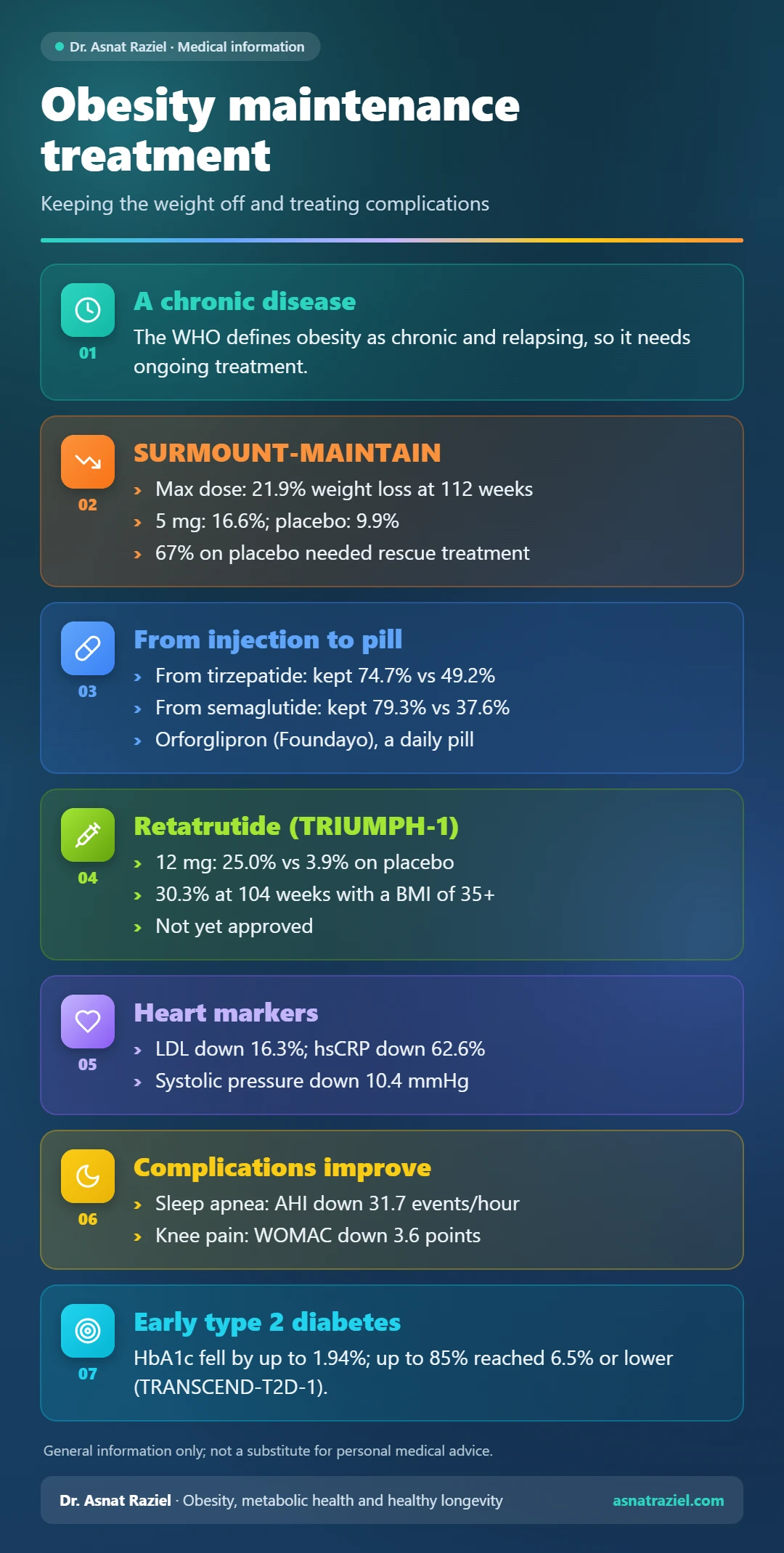
The SURMOUNT-MAINTAIN trial appeared in The Lancet in May 2026. It tackled the question every doctor and patient asks: what happens after major weight loss? To answer it, the trial enrolled 441 adults with obesity in the United States. First, they received tirzepatide, the active ingredient in Mounjaro, for 60 weeks.
Next, the researchers randomly assigned 378 participants to three groups for another 52 weeks. One group continued on the maximum dose, 10 or 15 mg. A second group stepped down to 5 mg, and the third switched to placebo. After 112 weeks in total, the picture was clear:
- A 21.9% weight reduction in the maximum-dose group.
- A 16.6% reduction in the 5 mg group.
- Only a 9.9% reduction in the placebo group.
The most striking figure: 67% of patients on placebo needed rescue treatment, because they regained at least half of the weight they had lost. By contrast, only 8% in the maximum-dose group and 25% in the 5 mg group needed it. In other words, stopping treatment leads in most cases to a real loss of what patients achieved.
Low-dose obesity maintenance treatment: a new paradigm
The conclusion is not that every patient must stay on the high dose forever. Quite the opposite. The trial shows that it is sometimes possible to move to a lower maintenance dose and still keep much of the benefit. In fact, obesity maintenance treatment resembles treatment for high blood pressure. The doctor adjusts the dose over time, according to the patient’s needs and response.
ATTAIN-MAINTAIN: obesity maintenance treatment in pill form
Many patients do very well on a weekly injection. Even so, some of them later prefer a convenient pill. The ATTAIN-MAINTAIN trial, published in Nature Medicine, examined exactly this question. The researchers switched patients from injections to orforglipron, a once-daily GLP-1 pill. The FDA approved the drug in April 2026 under the name Foundayo.
The participants came from the SURMOUNT-5 trial, where they had received tirzepatide or semaglutide. After 52 weeks, those who switched from tirzepatide to the pill kept an average of 74.7% of their weight loss, compared with 49.2% on placebo. Those who switched from semaglutide kept 79.3%, compared with 37.6% on placebo. In addition, the trial met all of its key secondary goals.
The biological explanation makes sense. Tirzepatide acts on two hormonal pathways, GLP-1 and GIP, while orforglipron acts on GLP-1 alone. So moving from a more powerful treatment to a more targeted one has a certain “price” in weight. On the other hand, switching between two drugs with the same mechanism preserves most of the result. You can find more details in my article on maintaining weight with a daily pill.
Retatrutide: the triple agonist
If tirzepatide launched the revolution, retatrutide may mark the next stage. It is an experimental drug that acts on three receptors: GLP-1, GIP and glucagon. The TRIUMPH-1 trial appeared in NEJM in September 2026. It enrolled 2,339 adults with obesity and without diabetes for 80 weeks.
On the 12 mg dose, participants lost an average of 25.0% of their weight, compared with 3.9% on placebo. In this analysis of all participants, 36.9% lost at least 30% of their weight, and 21.1% lost at least 35%. Among those who stayed on treatment, weight loss reached 28.3%. Later in the trial, in a group of 532 participants with a BMI of 35 or more, weight loss reached 30.3% after 104 weeks.
In the past, results like these were seen almost only with bariatric surgery. However, retatrutide has not yet received approval. You can read more in my article on the triple agonist retatrutide.
Are the drugs competing with surgery?
For decades, bariatric surgery was the most effective treatment for severe obesity. Today, however, the gap is narrowing. Surgery still has a unique advantage: many years of experience and long-term follow-up data. But for the first time in history, medications are approaching the effectiveness of surgery. I have also written a full comparison of obesity drugs and bariatric surgery.
Not just weight: the heart, inflammation and blood pressure
Retatrutide also improved important markers of heart health. In TRIUMPH-1, on the 12 mg dose, LDL, the “bad” cholesterol, fell by 16.3%, compared with 4.7% on placebo. In addition, hsCRP, a blood marker of chronic inflammation, fell by 62.6%, compared with 24.9%. Systolic blood pressure dropped by 10.4 mmHg, compared with 1.9 on placebo. On the other hand, some patients had symptoms of low blood pressure, mainly those taking blood pressure medication.
Complication-focused obesity maintenance treatment
One of the new ideas is a shift from a “weight-centered” approach to a complication-based one. Instead of asking how many kilograms we lost, we ask which diseases improved as a result of the weight loss.
Obstructive sleep apnea
TRIUMPH-1 included a subgroup of 243 people with obstructive sleep apnea. At the start of the trial, they had an average of 58.6 events per hour. On the 12 mg dose, their AHI, the number of breathing pauses per hour of sleep, fell by 31.7 events, compared with 9.9 on placebo. An improvement like this may boost alertness, sleep quality and daily functioning. Read about the link between the two in my article on obesity and sleep apnea.
Knee osteoarthritis
Another TRIUMPH-1 subgroup included 574 people with knee osteoarthritis, the wear-and-tear form of arthritis. On the 12 mg dose, the WOMAC pain score fell by 3.6 points, compared with 1.9 on placebo. In other words, deep weight loss also eases mechanical conditions caused by excess load. I have written more on retatrutide and joint pain, too.
TRANSCEND-T2D-1: early-stage diabetes
The TRANSCEND-T2D-1 trial was presented in June 2026 and published in The Lancet. It enrolled 537 adults with early-stage type 2 diabetes who had not received any previous drug treatment. At baseline, their average HbA1c, the average blood sugar over the previous three months, was 7.9%.
After 40 weeks, this marker fell by up to 1.94%, compared with 0.84% on placebo. Up to 85% of participants reached an HbA1c of 6.5% or lower. In addition, up to 46% reached normal values, below 5.7%. Weight also dropped by up to 16.8%, an unusual rate among people with diabetes. Interestingly, once blood sugar is very well controlled, further weight loss does not always lower HbA1c any more. However, it continues to benefit blood pressure and blood lipids and to reduce heart risk.
Personalized medicine: obesity maintenance treatment for each person
There is no longer one treatment that fits everyone. Personalization rests on several factors:
- The type of complications the patient has.
- The metabolic phenotype, meaning each person’s biological pattern.
- Eating patterns.
- Age and muscle mass.
- Functional risk.
Instead of choosing between medication, nutrition, physical activity or surgery, we build a combined and flexible path. That is also how the European framework for personalized treatment works, putting the person at the center.
The bottom line on obesity maintenance treatment
SURMOUNT-MAINTAIN showed that stopping treatment leads to weight regain in most cases. ATTAIN-MAINTAIN showed that it is possible to switch from an injection to a pill and keep most of the achievement. In addition, TRIUMPH-1 demonstrated that the new drugs are approaching the effectiveness of surgery. Finally, TRANSCEND-T2D-1 showed that deep treatment also changes the course of diabetes in its early stages.
The message of 2026 is clear: obesity maintenance treatment measures success by the ability to preserve results over time. It aims to reduce complications, improve quality of life and match the right treatment to the right person. This is the move from weight medicine to health medicine.
The information in this article is general and does not replace personal medical advice.
References
Retatrutide, a Triple Hormone Receptor Agonist, for Treatment of Obesity
Retatrutide Achieves Up to 30.3% Average Weight Loss in Phase 3 TRIUMPH-1 Trial
WHO issues global guideline on the use of GLP-1 medicines in treating obesity
The trials were funded by Eli Lilly, the manufacturer of tirzepatide, orforglipron and retatrutide.




