By Dr. Asnat Raziel, bariatric surgeon specializing in obesity treatment, metabolic health and healthy longevity; Director of the Multidisciplinary Center for Obesity Treatment, Assia Medical, Assuta Ramat HaChayal, Tel Aviv
Anti-aging drugs reach the FDA’s agenda
Anti-aging drugs got a tailwind from the US regulator in early October. At the ARDD meeting in Boston, senior officials of the FDA, the US Food and Drug Administration, announced that aging and longevity will be included in the agency’s scientific work plan. In addition, they described what the path to approving a treatment aimed at the aging process itself might look like. Even so, the FDA has not yet approved any drug to treat aging.
What happened at the ARDD meeting in Boston?
The ARDD (Aging Research and Drug Discovery) meeting is one of the oldest and largest longevity conferences in the world. In previous years it took place in Copenhagen, but this year it moved to Boston and ran for three days, from October 1 to 3, 2026. According to a report by the Lifespan Research Institute, the first day focused on policy, regulation and the move from the lab to the clinic.
At the center of the day was a panel of four senior FDA officials. Andrew Brack, a program manager at ARPA-H, the US Advanced Research Projects Agency for Health, moderated the panel. Lowell Zeta, a senior official in the FDA Office of the Commissioner, described the moment as a turning point for the agency. In his words, the topic matters to the FDA and to the entire US Department of Health and Human Services.
The key announcement: aging in the FDA’s science plan
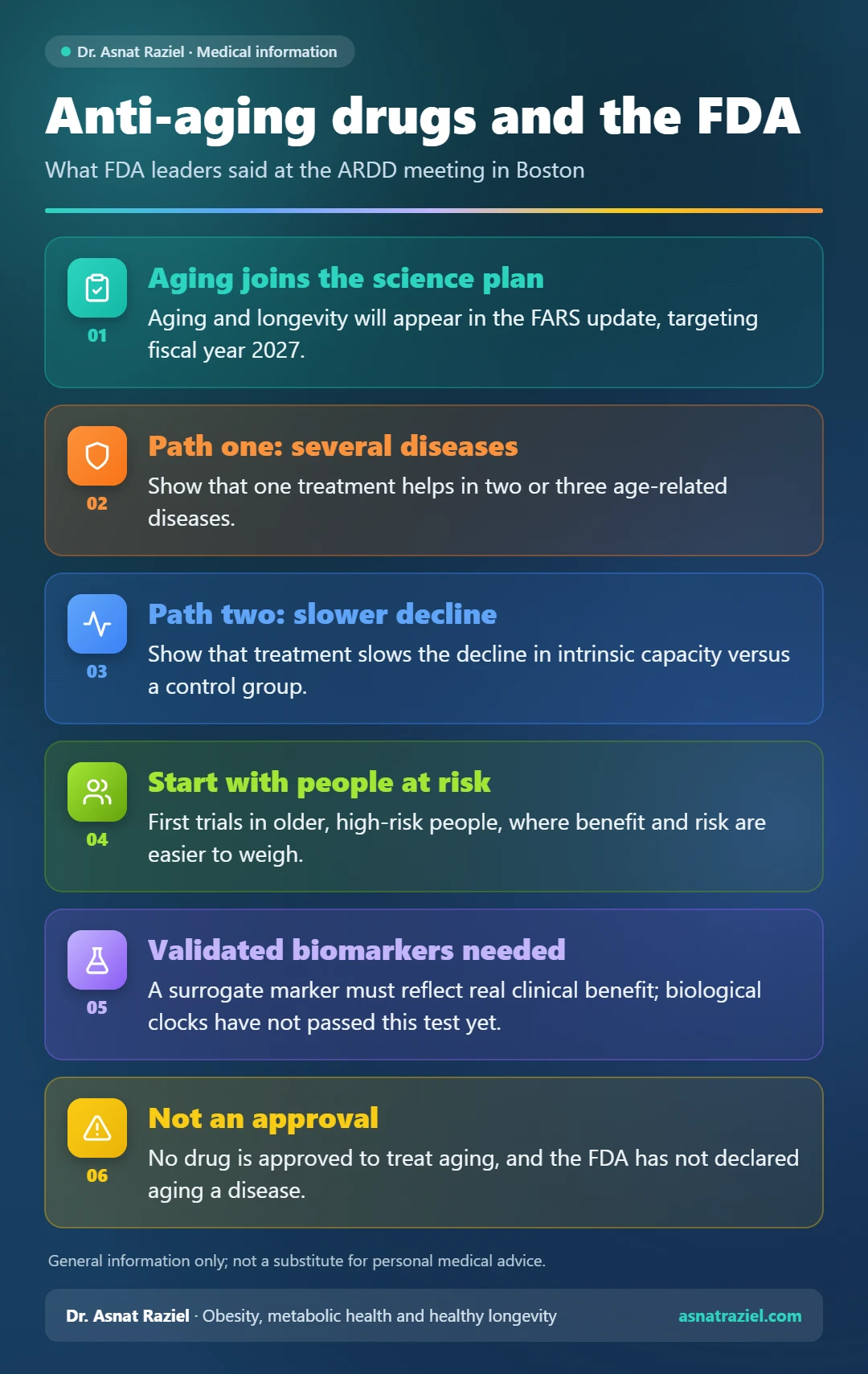
The most concrete news came from Stephen Kozlowski, the FDA’s chief scientist. He said that aging and longevity will appear in the upcoming update of the Focus Areas of Regulatory Science (FARS). This is a guiding document that defines which research areas the agency invests in. At that point, the audience in the hall applauded.
Kozlowski named federal fiscal year 2027, which began on October 1, 2026, as the target. According to a report by GEN, the previous version came out in 2022, and the terms “aging research” and “longevity medicine” did not appear in it at all.
How does the FDA see the path to approving anti-aging drugs?
Jeffrey Siegel, director of the FDA’s drug evaluation office, presented two possible approaches. Both aim to show that a drug affects aging broadly, not just a single disease. This is where the term gerotherapeutics comes in: drugs that target the biological mechanisms of aging.
Approach one: protection against several diseases
Under the first approach, researchers would gather evidence that the same treatment helps in several age-related diseases. For example, these could include heart disease, neurodegenerative brain diseases and certain cancers. When one mechanism affects two or three such diseases, it becomes possible to think about a general effect on aging.
Approach two: slowing functional decline
The second approach relies on the concept of intrinsic capacity, meaning the sum of a person’s physical and mental capacities. In this case, a trial would measure the decline in several capacities over time in a defined population. Then the researchers would test whether the treatment slows that decline compared with a control group.
The challenge: proving an effect beyond the known benefit
Justin Penzenstadler, acting deputy director of the Office of Cardiology, Hematology, Endocrinology and Nephrology, expects the first trials to focus on age-related disease or on mortality. At the same time, collecting function measures in those same trials could establish new endpoints for future trials.
Penzenstadler added an important caveat. If a cardiometabolic drug extends life thanks to its known effect on the heart, that does not prove a broad effect on aging. This question is especially relevant for drugs like Wegovy and Mounjaro, which are also being studied in the context of biological age. I wrote in a separate article about the chance that they will be the first in this field.
The FDA and the safety of anti-aging drugs: start with people at risk
Anti-aging drugs pose a complex balance of benefit versus risk. Treatment may last for decades, the benefit may be modest, and a healthy person’s baseline risk is low. Penzenstadler described the dilemma this way: we might treat someone for thirty years to gain two.
That is why he prefers to start with trials in older, high-risk people. In such a population, he said, it is much easier to weigh the benefit against the risk.
The FDA and aging biomarkers: a shortcut to approval
Biomarkers, measurable signals in blood or tissue that reflect a process in the body, can shorten long trials. They may serve as a substitute for clinical outcomes such as disease or death. However, this will happen only when there is evidence that they reflect real benefit.
Siegel distinguished between two types. First, a prognostic marker predicts future risk. A surrogate marker, by contrast, changes with treatment, and that change reflects the clinical benefit that follows. Even the biological clocks we know today have not yet passed this test.
What the FDA is asking of researchers and companies
Penzenstadler’s first recommendation was to set up a shared consortium for companies, before they start competing with each other. The goal is to define in advance a fixed set of biomarkers for all trials. That way, different companies could pool their data and validate the markers together. His second recommendation was to hold regular, structured meetings between regulators, researchers and industry.
Some of these recommendations are already happening. The planned TAME trial, which will test metformin, will look at several diseases of aging at once. The XPRIZE Healthspan competition focuses on muscle function, cognition and the immune system. In addition, the Biomarkers of Aging Consortium is advancing joint work on measurement tools.
Finally, the panel also gave companies a clear point of contact. Penzenstadler noted that his office is responsible for aging as an indication. He encouraged companies to submit real protocols through the IND pathway (Investigational New Drug, an application to approve a trial of a new drug).
What does the FDA’s move mean for anti-aging drugs today?
First, it is important to be precise: the announcement is not an approval of any drug. Nor did the FDA declare aging a disease. A summary of a Reagan-Udall Foundation meeting from July 2026 notes that there is no approved indication for aging, and there is still no validated aging biomarker.
Some speakers at the meeting itself also urged caution. According to GEN, George Daley, dean of Harvard Medical School, opened the meeting with a call to look critically at promises of longer life. Similarly, I have written before about the gap between the pace of marketing and the pace of science in the longevity world.
On the other hand, the long-term meaning is significant. Healthspan, the number of years we live in good health and good function, is becoming a goal the regulator is willing to discuss. Meanwhile, the tools we already have remain valid: exercise, sleep, nutrition and treating metabolic disease. I covered this in more depth in my article on longevity medicine between science and the clinic.
The bottom line
Senior FDA officials now speak openly about the path to approving anti-aging drugs. They presented two routes to proof, stressed safety and the need for validated markers, and asked industry to cooperate. This is a first step on a long road, not the end of it.
The information in this article is general only and is not personal medical advice. Before making any change to your treatment, consult your treating doctor.
References
FDA Leaders Name Longevity a Priority at ARDD
FDA to Highlight Aging, Longevity Medicine in Planned FARS Updates




