By Dr. Asnat Raziel, bariatric surgeon specializing in obesity treatment, metabolic health and healthy longevity; Director of the Multidisciplinary Center for Obesity Treatment, Assia Medical, Assuta Ramat HaChayal, Tel Aviv
The SURPASS-CVOT trial: what it proved about Mounjaro and the heart
The SURPASS-CVOT trial answers a question raised by almost every patient with type 2 diabetes who comes to see me. Mounjaro is known for lowering weight and blood sugar. But what does it do for the heart? This large trial provided an answer, and following it, the FDA granted Mounjaro a new indication for reducing cardiovascular risk.
In this article, I explain exactly what was found, what the numbers mean and what is still unknown.
What Mounjaro is and how it works
Mounjaro is the brand name for tirzepatide, a once-weekly injection. It activates two gut-hormone receptors: GIP and GLP-1. As a result, the pancreas releases insulin when blood sugar rises, appetite falls and food stays in the stomach longer. In trials, the drug substantially lowered both HbA1c (glycated hemoglobin, a measure of average blood sugar over three months) and body weight.
Blood sugar and weight, however, are closely tied to the heart. Diabetes roughly doubles the risk of heart attack and stroke, and excess weight adds to that risk further. I have written more about this link in my article on cardiovascular risk in obesity. So the important question is not only how many kilograms come off, but whether there are fewer cardiovascular events.
The SURPASS-CVOT trial: Mounjaro versus Trulicity
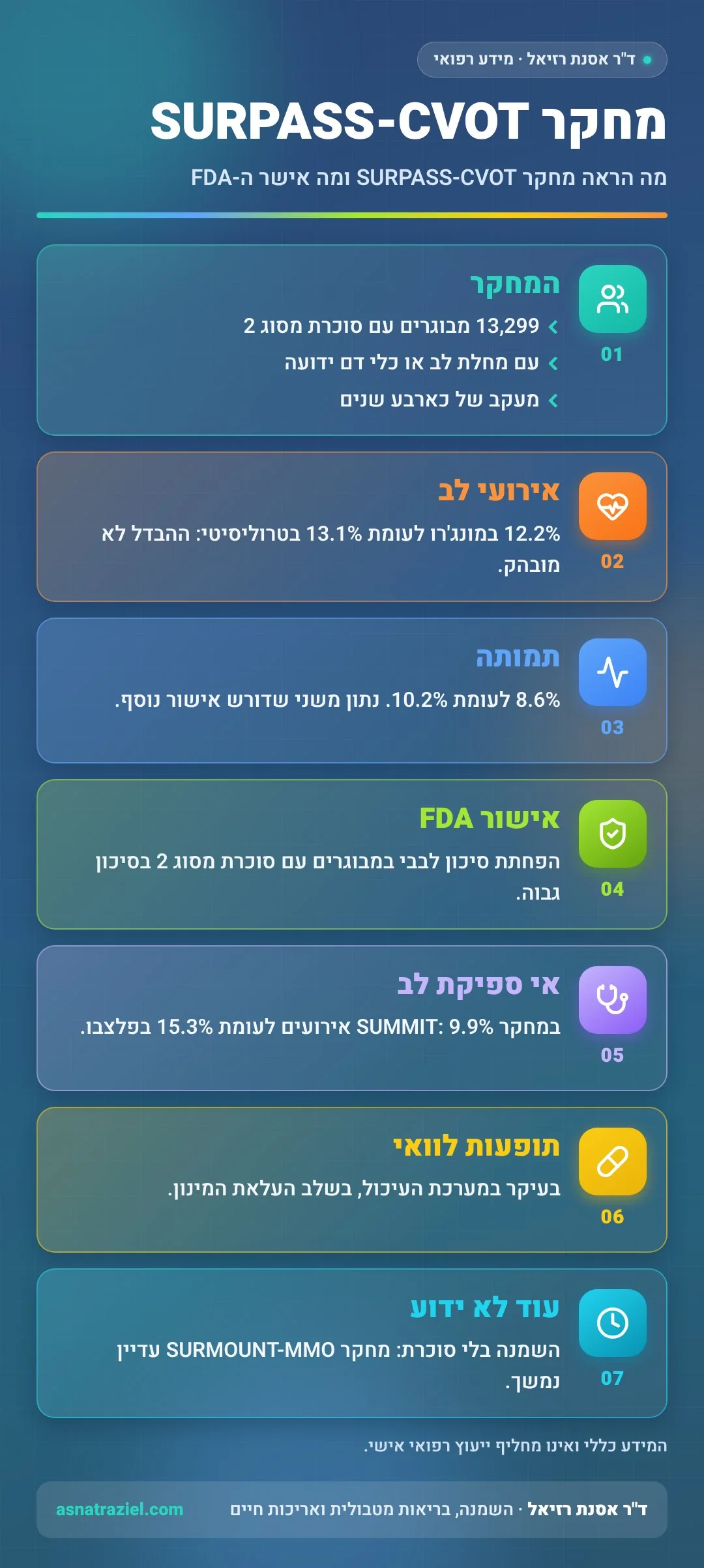
To answer that question, Lilly ran the SURPASS-CVOT trial. It enrolled 13,299 adults with type 2 diabetes and established atherosclerotic cardiovascular disease at 640 centers in 30 countries. Unlike many trials, the comparison was not with placebo. Instead, the researchers compared Mounjaro with Trulicity (dulaglutide), a GLP-1 drug that had already been shown to protect the heart.
Participants received Mounjaro at up to 15 mg a week, or Trulicity at 1.5 mg a week. Median follow-up was about four years. The results were published in The New England Journal of Medicine (NEJM).
What the SURPASS-CVOT trial found
The primary endpoint was a composite of cardiovascular death, heart attack and stroke. Such an event occurred in 12.2% of patients on Mounjaro, compared with 13.1% on Trulicity, a relative reduction of 8%. Statistically, Mounjaro was shown to be noninferior to Trulicity, but not significantly superior to it.
Secondary measures were also examined. Death from any cause was 8.6% with Mounjaro versus 10.2% with Trulicity. However, the researchers regard this figure as preliminary, because it was not the trial’s primary endpoint. In a further analysis presented at the American College of Cardiology meeting, major kidney events occurred in 4.9% of patients on Mounjaro versus 6.1% on Trulicity. This, too, is a secondary analysis and should be read with caution.
What about blood sugar and weight? Here, too, Mounjaro came out ahead. Weight loss was 6.8% greater than with Trulicity, and HbA1c also fell further.
FDA approval following the SURPASS-CVOT trial
On August 28, 2026, Lilly announced that the FDA had granted Mounjaro a new indication. The drug is now also indicated to reduce the risk of major adverse cardiovascular events in high-risk adults with type 2 diabetes. These events are cardiovascular death, nonfatal heart attack and nonfatal stroke. According to the announcement, the trial data have also been added to the drug’s label in the European Union. I have also written about the implications of this approval in my articles on Mounjaro and heart health and on Mounjaro and cardiovascular risk.
It is important to understand the limits of this indication. It was granted for people with type 2 diabetes. For patients with obesity but without diabetes, no cardiovascular outcomes trial has been completed yet. The SURMOUNT-MMO trial includes about 15,000 such participants, and primary data collection is expected to be completed in October 2027.
Heart failure and obesity
Beyond heart attacks, there is also evidence in the type of heart failure that is common in obesity, heart failure with preserved ejection fraction (HFpEF). The SUMMIT trial enrolled 731 patients with obesity and this form of heart failure. Cardiovascular death or worsening heart failure occurred in 9.9% of patients on Mounjaro, compared with 15.3% on placebo. Patients also reported improved quality of life. On the other hand, 6.3% stopped the drug because of side effects, mainly gastrointestinal.
Mounjaro and the heart: who this applies to
- First, adults with type 2 diabetes and known heart disease, for example after cardiac catheterization or a heart attack.
- Second, people with diabetes and high cardiovascular risk, as assessed by their doctor.
- In addition, patients with obesity and heart failure with preserved ejection fraction, in line with the SUMMIT trial.
It is also important to compare with other drugs. Wegovy (semaglutide) has been shown to reduce cardiovascular events in people with obesity even without diabetes, in the SELECT trial. Real-world data on Mounjaro and the heart also point in the same direction. The decision about which drug is right is a personal one.
Safety and side effects
In the cardiovascular trial, the most common side effects were gastrointestinal: nausea, diarrhea, vomiting and constipation. Most were mild to moderate and occurred mainly while the dose was being increased. According to the prescribing information, the drug must not be used by people with a personal or family history of medullary thyroid cancer or MEN 2 syndrome. Pancreatitis and gallbladder problems should also be watched for. Full details are in my guide to Mounjaro side effects.
Finally, the drug does not replace existing heart treatment. Statins, blood pressure treatment, quitting smoking and physical activity remain the foundation.
The bottom line
The relationship between Mounjaro and the heart has become clearer. The SURPASS-CVOT trial showed that Mounjaro protects the heart at least as well as Trulicity, a drug with proven cardiovascular protection. It also lowered weight and blood sugar more. As a result, the FDA approved it to reduce cardiovascular risk in type 2 diabetes. On the other hand, it was not shown to be superior on the primary endpoint, and in obesity without diabetes the answer is not yet known. If you have diabetes and heart disease, it is worth talking to your doctor about tailoring your treatment.
The information in this article is general and does not replace personal medical advice.
Frequently asked questions
Does Mounjaro prevent heart attacks?
In the SURPASS-CVOT trial, there were slightly fewer events than with Trulicity, but the difference was not significant. In other words, the protection is similar to that of Trulicity, which had already been proven.
Does the approval also cover people without diabetes?
No. The FDA’s cardiovascular indication was granted for high-risk adults with type 2 diabetes. A trial in obesity without diabetes is still underway.
Can I stop my heart medications when I start Mounjaro?
No. Mounjaro is added to existing treatment. Do not stop statins or blood pressure medications without your doctor’s guidance.
What dose was tested in the SURPASS-CVOT trial?
Patients received up to 15 mg a week, or the highest dose they could tolerate. The dose is increased gradually to reduce side effects.
References
Cardiovascular Outcomes with Tirzepatide versus Dulaglutide in Type 2 Diabetes
Tirzepatide for Heart Failure with Preserved Ejection Fraction and Obesity
The SURPASS-CVOT and SUMMIT trials were funded by Eli Lilly.




