By Dr. Asnat Raziel, bariatric surgeon specializing in obesity treatment, metabolic health and healthy longevity; Director of the Multidisciplinary Center for Obesity Treatment, Assia Medical, Assuta Ramat HaChayal, Tel Aviv
Stopping weight loss medication: the full picture
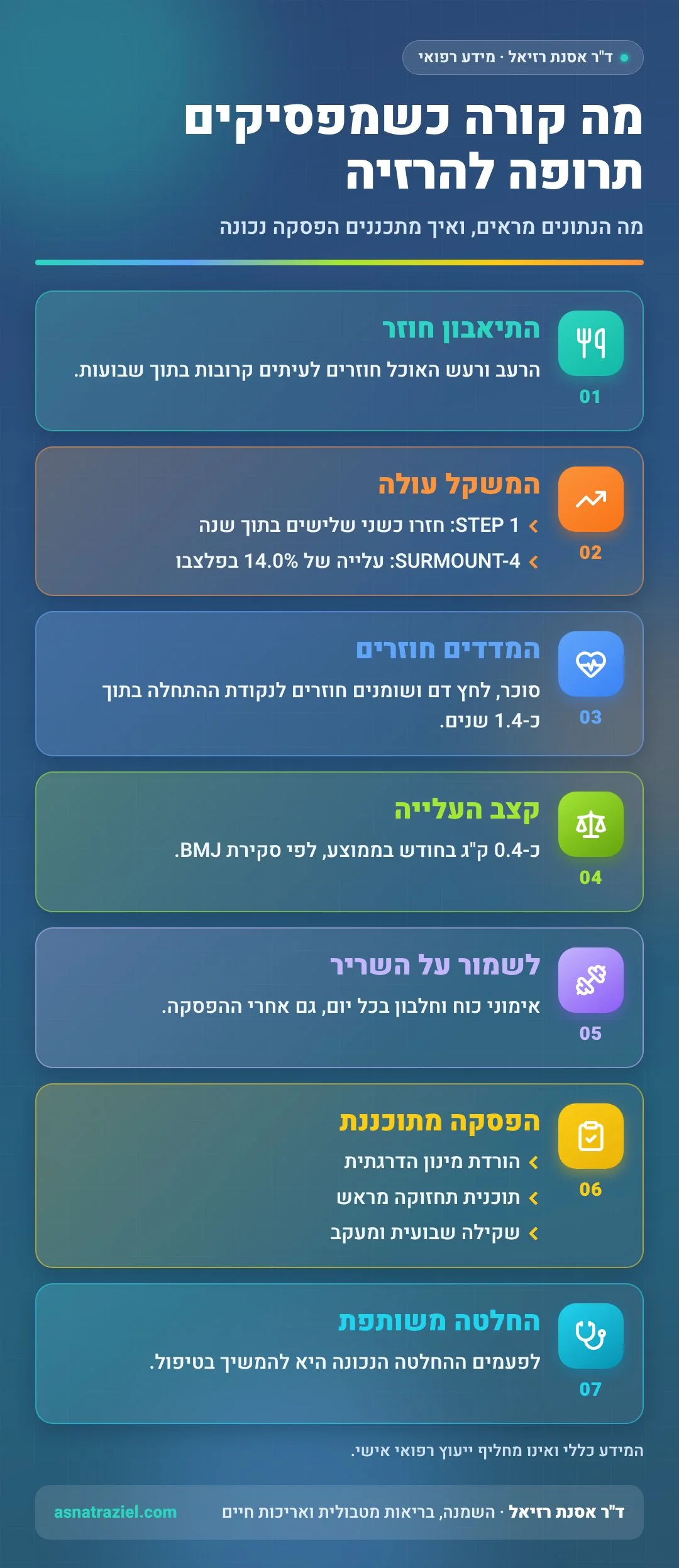
What happens when you stop weight loss medication? For most patients, appetite comes back within weeks and the weight starts to creep up. Within a year, many regain a large share of the weight they lost. The improvements in blood sugar, blood pressure and blood fats also fade gradually. Even so, stopping weight loss medication in a planned way, with a clear maintenance plan, can help you hold on to part of what you achieved.
In this article I’ll explain what happens in the body after you stop, what the data show, and how to prepare for it properly.
Why the body “waits” for the medication
GLP-1 medications mimic the body’s natural satiety hormones. They slow the emptying of the stomach and calm the hunger centers in the brain. You can read more about the biology behind weight loss medications, as well as about satiety hormones and the role they play.
The catch is that the medication doesn’t “cure” the disease; it keeps it in check only for as long as you take it. What’s more, after weight loss the body ramps up hunger and lowers energy expenditure in an effort to return to its previous weight. That is why obesity is a chronic disease. Anyone interested in the history of weight loss injections will see how this understanding has developed over the years.
What happens to your weight when you stop
The research here is very clear. In the extension of the STEP 1 trial, researchers followed 327 participants who stopped semaglutide after 68 weeks. They had lost an average of 17.3% of their body weight, and within a year they regained about two-thirds of that loss. By the end of follow-up, the net weight loss was only 5.6%.
In the STEP 4 trial, all participants took semaglutide for 20 weeks, after which some were switched to placebo. Those who stayed on the drug lost a further 7.9%, while those switched to placebo gained 6.9%. Similarly, in the SURMOUNT-4 trial of tirzepatide, participants first lost 20.9% of their body weight. Afterward, those switched to placebo regained 14.0%, compared with a further 5.5% loss among those who continued. In addition, 89.5% of those who continued maintained at least 80% of their weight loss, compared with only 16.6% in the placebo group.
What happens to your appetite when you stop
The first thing patients notice is that hunger returns. Food noise, the constant stream of thoughts about food, often comes back within weeks.
That’s why it’s important to have coping tools ready in advance. I have gathered practical tips in my article on constant hunger after stopping medication.
What happens to blood sugar, blood pressure and blood fats
Weight loss improves blood sugar, blood pressure and blood fats. But in the STEP 1 follow-up, most of these improvements drifted back toward their starting point a year after stopping. In other words, the metabolic protection weakens as the weight returns.
In January 2026, the BMJ published a review of 37 studies involving 9,341 participants. The researchers found an average regain of about 0.4 kg per month after stopping weight loss medications. By their estimate, all the metabolic markers return to baseline within about a year and a half (1.4 years). The regain was also 0.3 kg per month faster than after lifestyle change programs.
What happens to your muscles
Any weight loss also involves losing some muscle mass. If the weight comes back without strength training, it is hard to rebuild the muscle that was lost. That’s why I recommend combining strength training with a protein-rich diet throughout treatment, and especially in the period after stopping.
Stopping weight loss medication gradually and with a plan
Stopping doesn’t have to be abrupt. You can taper the dose gradually, move to a low maintenance dose, or switch to a different medication. I have written about this in detail in my article on tapering off weight loss medications.
Beyond that, it’s worth building a maintenance plan before you stop. A VCU Health guide on creating a maintenance plan emphasizes protein every day, a combination of aerobic exercise and strength training, and weekly weigh-ins. I describe more tools in my article on stopping GLP-1 medications without regaining it all.
Switching from an injection to a pill
A newer option is to switch from a weekly injection to a daily pill. In the ATTAIN-MAINTAIN trial, adults who had lost weight on injectable tirzepatide or semaglutide were switched to Foundayo (orforglipron) or to placebo for one year. Those who switched from semaglutide to the pill maintained 79.3% of their weight loss, compared with 37.6% on placebo. Among those who switched from tirzepatide, the figures were 74.7% versus 49.2%.
In other words, here too it is stopping treatment altogether that drives the regain, while continuing treatment in a different form preserves most of the result. The pill’s most common side effects were digestive, and most were mild to moderate.
When stopping is still the right call
There are good reasons to stop. Planning a pregnancy is one: according to the prescribing information, Wegovy should be stopped at least two months before a planned pregnancy. Severe side effects, planned surgery or cost may also lead to stopping.
Either way, the decision should be made jointly by you and your treating doctor. At our clinic, we build a personal exit plan for every patient. You can read more about medical treatment for obesity and about my approach on the page about Dr. Asnat Raziel.
The bottom line
What happens when you stop weight loss medication? In most cases appetite returns, weight goes up gradually, and the metabolic benefits disappear within about a year and a half. Still, a planned stop, backed by strength training, protein, follow-up and regular weigh-ins, can preserve part of the result. And sometimes the right decision is simply to stay on treatment long term.
The information in this article is general and does not replace personal medical advice.
Frequently asked questions
What happens if I stop weight loss medication after two years?
Even after long-term treatment, most patients regain some of the weight. The trials show that it is stopping itself, not the length of treatment, that leads to regain.
Can I stop all at once?
Stopping immediately poses no direct medical danger. However, tapering the dose gradually, together with a maintenance plan, helps you cope with returning hunger.
Can I go back on the medication after stopping?
Yes. In that case you start again at a low dose and increase it gradually, to reduce nausea and other side effects.
Sources
Adults switching from injectable drug to Foundayo maintain majority of weight loss
WEGOVY (semaglutide) prescribing information




