By Dr. Asnat Raziel, bariatric surgeon specializing in obesity treatment, metabolic health and healthy longevity; Director of the Multidisciplinary Center for Obesity Treatment, Assia Medical, Assuta Ramat HaChayal, Tel Aviv
What is the investigational drug retatrutide?
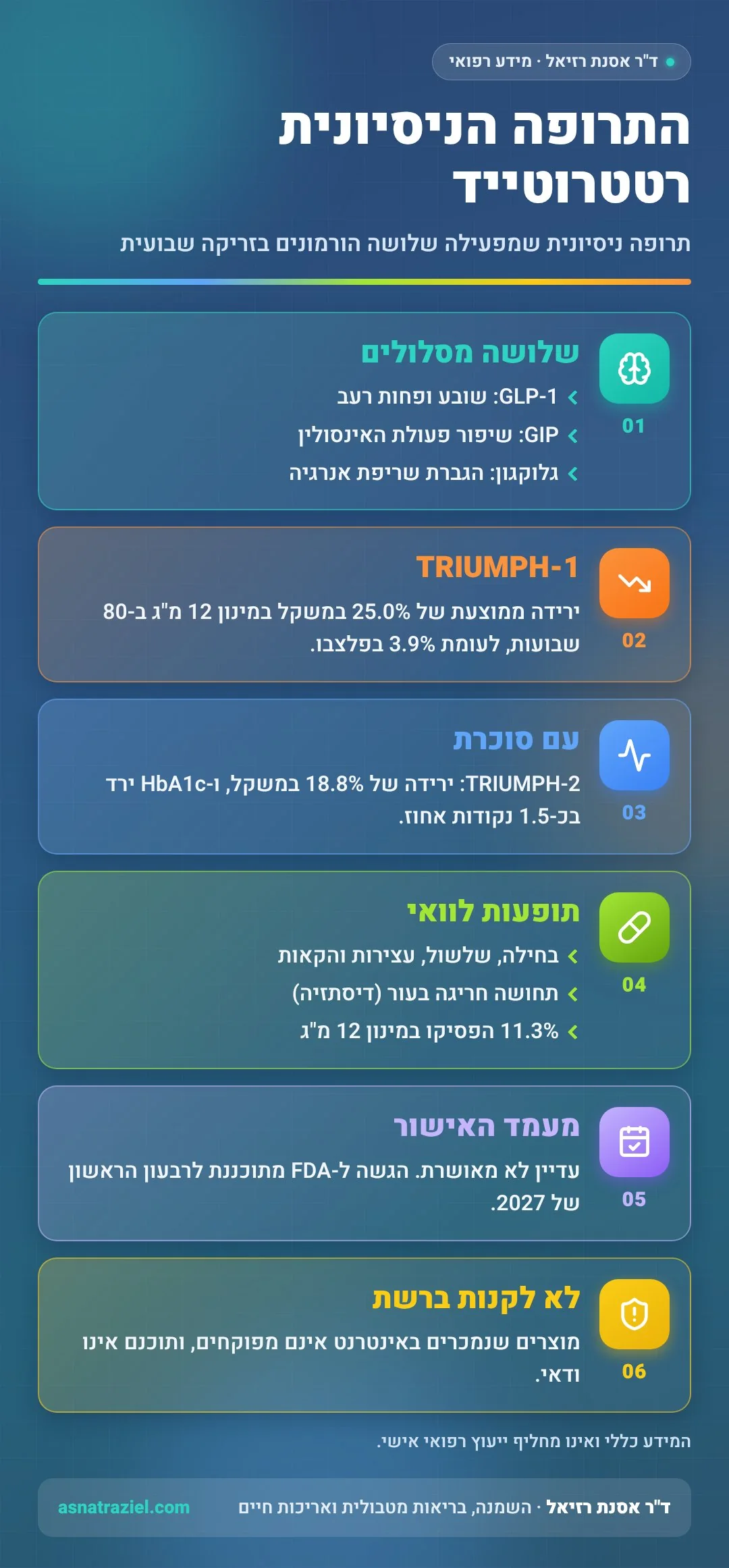
Retatrutide is an investigational drug for weight loss and the treatment of obesity, given as a once-weekly injection. It is the first medication to activate three hormone receptors at once. In phase 3 trials, patients on the highest dose lost an average of about a quarter of their body weight.
That said, it is important to be clear from the outset. As of October 2026, the drug has not been approved in any country, including Israel. In this article, I’ve gathered what we know about it today: how it works, what the trials found, what the risks are and when it might become available.
How retatrutide works in the body
The medications we know today act on one or two hormones. Wegovy activates GLP-1, a hormone that signals fullness to the brain. Mounjaro adds GIP, a hormone that improves the action of insulin. The new drug, by contrast, also activates the glucagon receptor.
Glucagon is a hormone that releases energy from the liver and increases fat burning. In other words, the drug doesn’t just reduce appetite; it also affects energy expenditure. It may also reduce liver fat. Its effect on the brain’s satiety centers may also quiet “food noise,” the constant, intrusive thoughts about food. For a detailed overview of the molecule, see Retatrutide on Wikipedia.
What the trials found about retatrutide and weight loss
The first evidence came from a phase 2 trial published in NEJM. The trial enrolled 338 adults with obesity. After 48 weeks, participants on the 12 mg dose had lost an average of 24.2% of their body weight, compared with 2.1% in the placebo group. Researchers later pooled the results of early clinical trials in a meta-analysis, that is, a combined analysis of several trials.
TRIUMPH-1: obesity without diabetes
The main trial, TRIUMPH-1, enrolled 2,339 adults with obesity and without diabetes. They received a weekly injection of 4, 9 or 12 mg, or a placebo injection, for 80 weeks. The results, in an analysis that also includes those who stopped treatment:
- 4 mg dose: average weight loss of 17.6%.
- 9 mg dose: average weight loss of 23.7%.
- 12 mg dose: average weight loss of 25.0%.
- Placebo group: weight loss of 3.9%.
What’s more, among participants with knee osteoarthritis, pain decreased significantly. And among participants with sleep apnea, the number of breathing interruptions fell markedly.
TRIUMPH-2: obesity with diabetes
The TRIUMPH-2 trial, published in The Lancet, enrolled 1,152 adults with obesity and type 2 diabetes. After 80 weeks, weight loss reached 18.8% on the 12 mg dose, compared with 5.1% in the placebo group. In addition, HbA1c, a measure of average blood sugar over the previous three months, fell by about 1.5 percentage points.
Other trials
TRIUMPH-4 studied 445 patients with knee osteoarthritis, and TRIUMPH-3 enrolled 1,949 patients with severe obesity and heart disease. In both trials, those who stayed on treatment at the highest dose lost an average of more than 20% of their body weight. However, TRIUMPH-3 was not designed to prove heart protection, and the number of cardiac events in it was small.
Side effects of retatrutide
The common side effects are similar to those of other GLP-1 medications: nausea, diarrhea, constipation and vomiting. In TRIUMPH-1, nausea occurred in 42.4% of patients on the 12 mg dose, compared with 14.8% in the placebo group. In addition, 11.3% of those on this dose stopped treatment because of side effects, compared with 4.9% in the placebo group.
A less familiar side effect also emerged: dysesthesia, an unpleasant or abnormal sensation in the skin. It occurred in 12.5% of patients on the highest dose, compared with 0.9% in the placebo group. The sensation was usually mild and faded during treatment. The phase 2 trial also recorded an increase in heart rate, which peaked at 24 weeks and declined afterward.
Can you get retatrutide today?
No, not outside a clinical trial. In July 2026, Eli Lilly announced that it plans to submit the drug to the FDA in the first quarter of 2027. Approval in the United States is therefore expected later that year at the earliest, and in Israel probably later still.
Even so, products presented as “retatrutide” are being sold online, usually labeled as a “research chemical.” The journal JAMA has warned against buying them, and a case report in BMJ has already described the hospitalization of a young woman with severe vomiting after such injections. There is no way of knowing what is really in the vial, at what concentration or with what level of purity. That’s why I strongly advise against buying medication from an unregulated source.
In the meantime, there are approved and highly effective medications available. You can find an overview of them on my obesity medication page.
The bottom line
Retatrutide is the first drug to act on three hormones, and in trials it led to an average weight loss of about a quarter of body weight. However, it is still investigational, and researchers are still collecting long-term safety data. As with any medication, success also depends on a healthy lifestyle, a protein-rich diet and strength training. If you are weighing your treatment options, consult a doctor who specializes in obesity, such as Dr. Asnat Raziel.
The information in this article is general and does not replace personal medical advice.
Questions and answers
Is retatrutide approved in Israel?
No. The drug has not yet been approved in any country. The manufacturer plans to submit it to the FDA in early 2027.
How is it different from Mounjaro?
Mounjaro acts on two hormones, GLP-1 and GIP. The new drug also adds glucagon, so it affects energy expenditure as well.
Is it safe to buy retatrutide online?
No health authority checks these products, and there is no certainty about what they contain. For that reason, using them is dangerous, and I recommend avoiding them.
What are the main side effects?
Mainly nausea, diarrhea, constipation and vomiting. Some patients also experienced an abnormal skin sensation, which usually went away on its own.
References
Retatrutide, a Triple Hormone Receptor Agonist, for Treatment of Obesity
Lilly’s triple agonist, retatrutide, delivered powerful weight loss in pivotal Phase 3 obesity trial
Triple-Hormone-Receptor Agonist Retatrutide for Obesity – A Phase 2 Trial
Unapproved GLP-1 Drugs Retatrutide and Zenagamtide Sold Online Are No Bargain