By Dr. Asnat Raziel, bariatric surgeon specializing in obesity treatment, metabolic health and healthy longevity; Director of the Multidisciplinary Center for Obesity Treatment, Assia Medical, Assuta Ramat HaChayal, Tel Aviv
CagriSema for obesity treatment: what it is and why everyone is talking about it
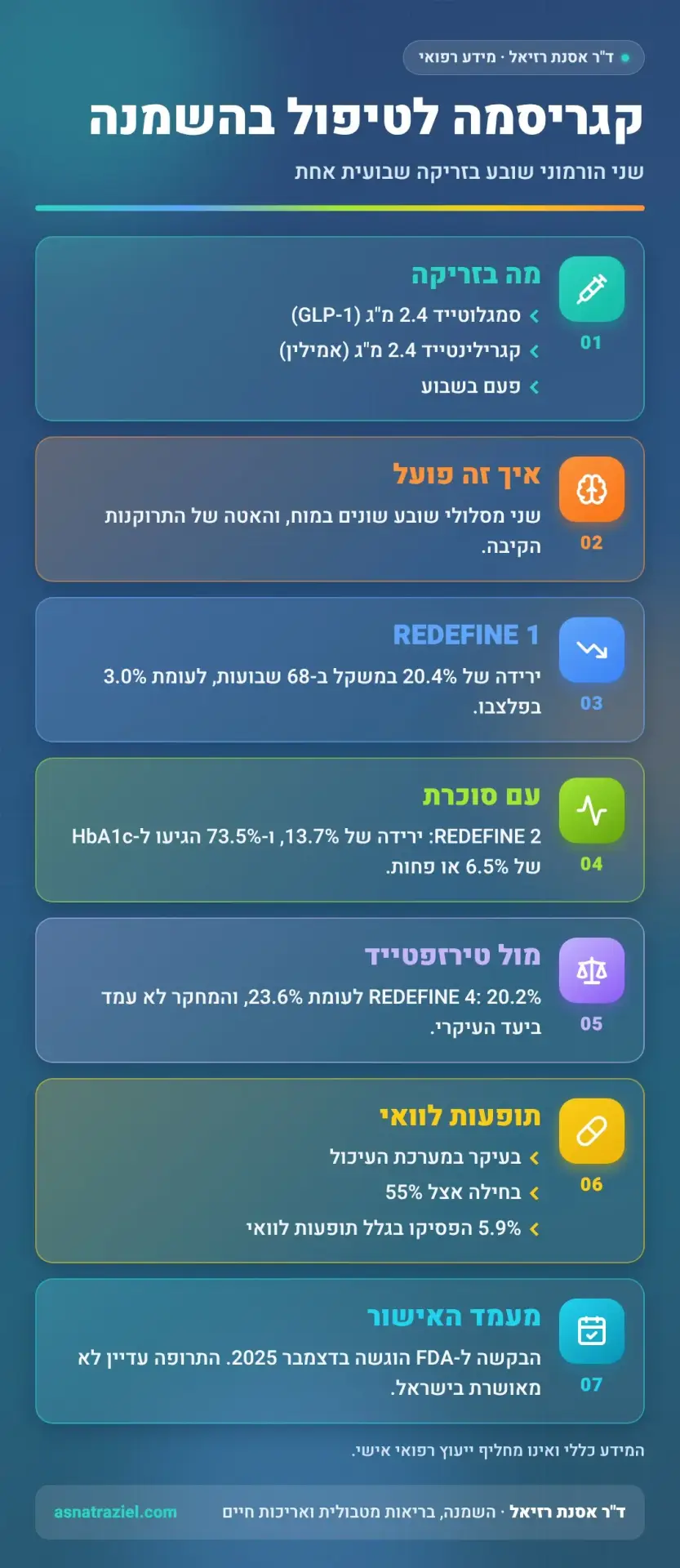
CagriSema for obesity treatment is a single weekly injection that combines two drugs. The first is semaglutide, the active ingredient in Wegovy. The second is cagrilintide, a new drug that mimics the hormone amylin. In the large clinical trials, participants lost about a fifth of their body weight on average.
That said, it is important to be precise. As of October 2026, the drug has not yet been approved for use in the United States, Europe or Israel. In this article I will explain how it works, what the studies found, what the side effects are and what to expect next.
How CagriSema works: two hormones in one injection
The body regulates hunger and fullness through several hormones. GLP-1 is a hormone the gut releases after a meal. It slows the emptying of the stomach and sends a satiety signal to the brain. Semaglutide mimics this hormone and keeps working throughout the week.
Amylin, by contrast, is a hormone the pancreas releases together with insulin. It also signals fullness to the brain, but through a different pathway. Cagrilintide activates both amylin and calcitonin receptors. That is why combining the two drugs tackles hunger from two directions at once. I have written about this mechanism in detail in a separate article on how amylin works.
What the REDEFINE trials found
The CagriSema research program is called REDEFINE. In every trial, the dose was 2.4 mg cagrilintide plus 2.4 mg semaglutide once a week, alongside lifestyle counseling. A broad review of the REDEFINE trials, as well as a detailed analysis of the program’s results, has already been published on this site. Here I will focus on the essentials.
REDEFINE 1: people with obesity without diabetes
This trial enrolled 3,417 adults and lasted 68 weeks. The results, published in NEJM, show an average weight loss of 20.4% with CagriSema, compared with 3.0% on placebo. The comparison with each component on its own is also revealing: semaglutide alone produced a 14.9% loss and cagrilintide alone 11.5%. In other words, the combination worked better than either component by itself.
What’s more, 19% of patients on CagriSema lost 30% or more of their body weight. Blood pressure improved as well. According to a blood pressure analysis from REDEFINE 1, systolic pressure fell by 10.9 mmHg, compared with 2.8 on placebo.
REDEFINE 2: people with obesity and type 2 diabetes
The second trial enrolled 1,206 adults with type 2 diabetes. In this trial, weight loss was 13.7%, compared with 3.4% on placebo. In addition, 73.5% of patients reached a glycated hemoglobin (HbA1c, a measure of average blood sugar over the previous three months) of 6.5% or less, versus only 15.9% on placebo. People with diabetes generally lose less weight, a pattern also seen with other medications.
REDEFINE 5: participants from Japan and Taiwan
A trial published in Lancet Diabetes & Endocrinology compared CagriSema with semaglutide alone in 331 participants. Weight loss was 18.4% with CagriSema, compared with 11.9% with semaglutide.
CagriSema vs. tirzepatide
The question my patients ask most often is how CagriSema measures up against tirzepatide, the active ingredient in Mounjaro. The REDEFINE 4 trial compared the two head to head over 84 weeks in 809 participants. According to the company’s February 2026 announcement, tirzepatide 15 mg led to a 23.6% weight loss, and CagriSema to 20.2%.
As a result, the trial missed its primary goal, which was to show that CagriSema is not inferior to tirzepatide. Keep in mind that this was an open-label trial, meaning participants knew which drug they were receiving. You can find the full details in my article on the head-to-head comparison of the two drugs.
Side effects of CagriSema
As with all GLP-1 medications, most side effects involve the digestive system. In REDEFINE 1, 79.6% of patients on CagriSema reported such a side effect, compared with 39.9% on placebo. According to company data, nausea occurred in 55%, constipation in 30.7% and vomiting in 26.1%.
In most cases, however, these effects were mild to moderate and eased over time. 5.9% of patients stopped treatment because of side effects, compared with 3.5% on placebo. A slow dose escalation, small meals and drinking enough fluids help a great deal. I have explained this in detail in my article on preventing digestive side effects.
When will CagriSema reach Israel?
Novo Nordisk submitted CagriSema to the FDA for approval in December 2025. According to the company’s announcement of the filing, a decision is expected during 2026. At the time of writing, no decision has been made, and the drug has not been approved in Europe or Israel. In addition, the REDEFINE 3 trial is now examining the drug’s effect on cardiovascular events in 7,076 participants.
In the meantime, we already have effective medications available. Deciding what suits each patient depends on weight, underlying conditions and personal preferences. I have written about this in my article on how to choose a weight-loss medication, and you can find a general overview on the page Medications for obesity and metabolic disease.
The bottom line
CagriSema for obesity treatment combines two satiety mechanisms in a single weekly injection and produced an average weight loss of 20.4% in the large trial. On the other hand, in a head-to-head comparison it did not match the results of tirzepatide, and it is still awaiting approval. Ultimately, it is another important option in the toolbox, not a magic solution. If you are considering medication, it is worth consulting a doctor who specializes in obesity.
The information in this article is general and does not replace personal medical advice.
Frequently asked questions
Is CagriSema approved for obesity treatment in Israel?
No. At the time of writing, the drug has not yet been approved in Israel, nor in the United States or Europe. The application for FDA approval is under review.
How much weight do people lose on CagriSema?
In REDEFINE 1, the average loss was 20.4% after 68 weeks. In people with type 2 diabetes, it was 13.7%. Results vary from person to person.
What is the difference between CagriSema and Wegovy?
Wegovy contains semaglutide alone. CagriSema adds cagrilintide, which mimics the hormone amylin. In the trial, the combination led to greater weight loss than semaglutide alone.
Does treatment need to continue long term?
Most likely, yes. Obesity is a chronic disease, and with similar medications most of the weight returned after treatment stopped. That is why it is important to plan the maintenance phase with your doctor in advance.
Sources
Coadministered Cagrilintide and Semaglutide in Adults with Overweight or Obesity
Cagrilintide-Semaglutide in Adults with Overweight or Obesity and Type 2 Diabetes
CagriSema Reduces Blood Pressure in Adults With Overweight or Obesity: REDEFINE 1
Design and baseline characteristics of the CagriSema cardiovascular outcomes trial (REDEFINE 3)
REDEFINE 4 head-to-head trial results – Novo Nordisk company announcement
Novo Nordisk files for FDA approval of CagriSema – company announcement
Cagrilintide/semaglutide – Wikipedia
All REDEFINE trials were funded by Novo Nordisk.




