By Dr. Asnat Raziel, bariatric surgeon specializing in obesity treatment, metabolic health and healthy longevity; Director of the Multidisciplinary Center for Obesity Treatment, Assia Medical, Assuta Ramat HaChayal, Tel Aviv
Survodutide and type 2 diabetes: what’s new?
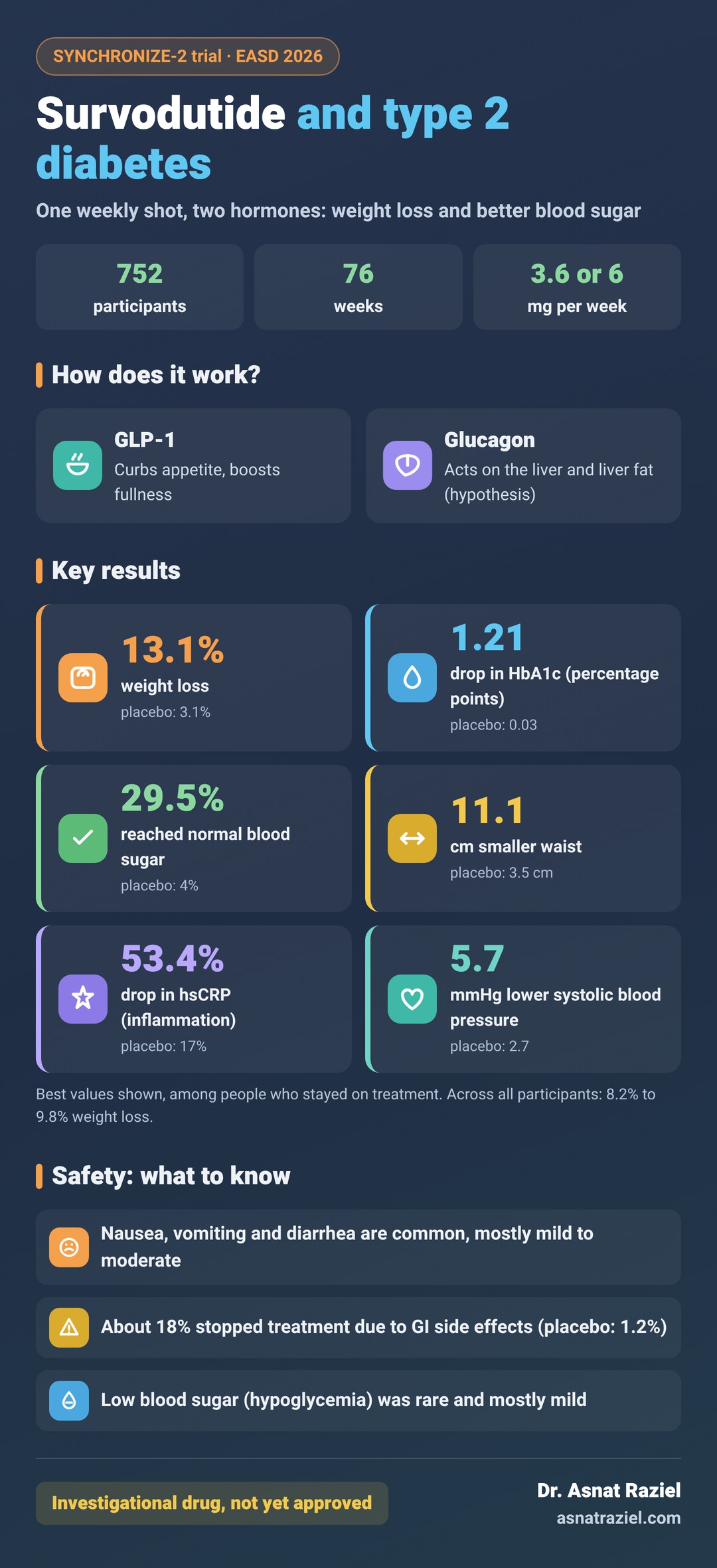
A new trial of survodutide in type 2 diabetes brings good news for a group that finds it especially hard to lose weight. In the SYNCHRONIZE-2 trial, people with obesity and diabetes received one injection a week. After 76 weeks, they lost up to 13.1% of their body weight, and their blood sugar clearly improved. The researchers presented the results at the European Association for the Study of Diabetes (EASD) meeting and, on the same day, published them in the New England Journal of Medicine.
Why is weight loss harder with diabetes?
Excess weight is a major risk factor for developing type 2 diabetes and for making it worse. Yet people with diabetes find it especially hard to lose a meaningful amount of weight. Even obesity medications have historically achieved more modest results in this group. That is why researchers are looking for treatments that work through several mechanisms at once.
How does the drug work?
Survodutide is an investigational drug from Boehringer Ingelheim. It is the first of its kind: a dual agonist, meaning a drug that activates the receptors of two hormones at the same time, GLP-1 and glucagon.
The first hormone, GLP-1, is familiar from drugs such as Ozempic and Wegovy. It curbs appetite and increases the feeling of fullness. The second hormone, glucagon, acts mainly on the liver. In theory, it helps reduce liver fat, regulate metabolism and lower inflammation and scarring. However, this is still a scientific hypothesis, not a mechanism that studies have confirmed.
Survodutide is also being studied in fatty liver disease. This time, however, the focus is on blood sugar control.
What did SYNCHRONIZE-2 test on survodutide and type 2 diabetes?
The trial enrolled 752 adults with type 2 diabetes and a body mass index (BMI) of 27 or higher. Their average age was 55.7, and their average BMI was 36.5. In addition, most participants also had high blood pressure and high blood lipids.
The researchers randomly assigned participants to three groups. Two groups received a weekly injection of survodutide, at a dose of 3.6 mg or 6 mg. The third group received a dummy injection (placebo). Treatment lasted 76 weeks, or about a year and a half.
How much weight did patients lose?
The researchers analyzed the data in two ways. The first analysis includes all participants, even those who stopped treatment. In this analysis, weight fell by 8.2% on the 3.6 mg dose and by 9.8% on the 6 mg dose. By contrast, the placebo group lost only 3.9%.
The second analysis looks at people who stayed on treatment for the whole trial. Here, weight loss reached up to 13.1%, compared with 3.1% on placebo. Waist size also shrank by 11.1 cm, compared with 3.5 cm on placebo.
What does this mean in simple terms? On the higher dose, 64.5% of participants lost at least 5% of their weight. In other words, almost two out of three patients. For comparison, 35.1% reached this goal on placebo. Among those who stayed on treatment, the rate reached up to 79.3%.
Survodutide and type 2 diabetes: what happened to blood sugar?
The main measure of diabetes control is glycated hemoglobin (HbA1c), which reflects average blood sugar over the past few months. At the start of the trial, the average value was 7.4%.
Across all participants, HbA1c fell by 0.9 percentage points on the 3.6 mg dose and by 0.8 on the 6 mg dose. On placebo, by contrast, it fell by only 0.2. Among those who stayed on treatment, the drop reached up to 1.21 percentage points, compared with 0.03 on placebo.
The most striking finding concerns a return to normal blood sugar (HbA1c below 5.7%). Up to 29.5% of patients who stayed on treatment got there, almost three in ten. On placebo, only 4% did. Moreover, hypoglycemia (a sharp drop in blood sugar) was rare, and most episodes were mild.
Beyond weight: blood pressure, inflammation and the liver
The trial also found improvements in other measures. First, systolic blood pressure fell by up to 5.7 mmHg, compared with 2.7 on placebo. Second, hsCRP, a blood test that measures chronic inflammation, fell by 50.2% on the lower dose and by 53.4% on the higher dose, compared with 17% on placebo. The researchers also reported better blood lipids and insulin sensitivity.
What about the liver? A parallel trial, SYNCHRONIZE-1, enrolled people with obesity but without diabetes. MRI scans showed that visceral fat and liver fat fell more than other tissues. Furthermore, according to the report, muscle made up no more than 10% of the tissue lost.
Side effects: what should you know?
As with other GLP-1 drugs, the common side effects were digestive: nausea, vomiting, diarrhea and constipation. They occurred in 72.8% of patients on 3.6 mg and 77.7% on 6 mg, compared with 38.6% on placebo. Most were mild to moderate.
Still, about 18% of patients stopped treatment because of digestive side effects, compared with 1.2% on placebo. Most of these stops happened while the dose was being increased, a phase in which the protocol allowed almost no flexibility. For this reason, the company notes that newer trials adjust the dose increase to each patient. Serious adverse events occurred at similar rates in all groups. I have covered the side effects of GLP-1 drugs in detail in a separate article.
What does this mean for patients?
It is important to stress that survodutide is not yet approved anywhere in the world. Results from a large trial testing its effect on the heart and blood vessels are expected later this year. In addition, a new trial called SYNCHRONIZE-T2D has already begun testing blood sugar control in people with diabetes.
Meanwhile, other drugs in development target the same group of patients, such as retatrutide in diabetes. Ultimately, treatment success is not measured in kilograms alone. We also look at blood sugar, blood pressure, the liver and inflammation, and above all at each patient’s personal goals.
Bottom line on survodutide and type 2 diabetes
The SYNCHRONIZE-2 trial adds important data on survodutide and type 2 diabetes. The drug led to significant weight loss, better blood sugar control and improvements in other metabolic measures. On the other hand, the rate of stopping treatment because of nausea and vomiting was high. So it is worth waiting for more data and for regulatory approval before we know where it fits in treatment.
This article provides general information and is not personal medical advice. Before making any change to your treatment, please consult your doctor.
References
Survodutide Once Weekly in Adults with Obesity and Type 2 Diabetes
Dual Agonist Survodutide Delivers Up to 13.1% Weight Loss in T2D
Survodutide induces ‘impressive’ amount of weight loss in type 2 diabetes and obesity
Boehringer Ingelheim funded the trial.




